

Quick Answer
Beginners can start profitable small businesses with ideas like freelance writing, virtual assistance, social media management, online tutoring, or dropshipping. Most require less than $500 to launch. Choose based on your skills, available time, and budget. Service-based businesses offer quickest income, while content and e-commerce models provide long-term scalability. Focus on solving real problems for customers you understand.
Introduction
Starting a small business has never been more accessible than it is right now. You don’t need a business degree, massive savings, or years of corporate experience. The digital economy has created countless opportunities for people who simply want to build something of their own.
In 2026, the landscape for new entrepreneurs looks remarkably different than it did even five years ago. Remote work normalized during the pandemic showed millions of people they could operate businesses from kitchen tables. Technology became cheaper and easier to use. Platforms emerged that handle complex tasks—payment processing, website hosting, marketing automation—that once required technical expertise.
According to the U.S. Small Business Administration, small businesses represent 99.9% of all U.S. businesses and employ nearly half of the private workforce. Many of these started exactly where you are now: with an idea, minimal capital, and determination to figure things out.
The beauty of beginning a business today is the low barrier to entry. You can test ideas with minimal financial risk. Launch a service business for under $100. Sell products without holding inventory. Build an audience before creating anything to sell. The traditional gatekeepers—banks demanding business plans, landlords requiring commercial leases, manufacturers insisting on minimum orders—no longer control who gets to be an entrepreneur.
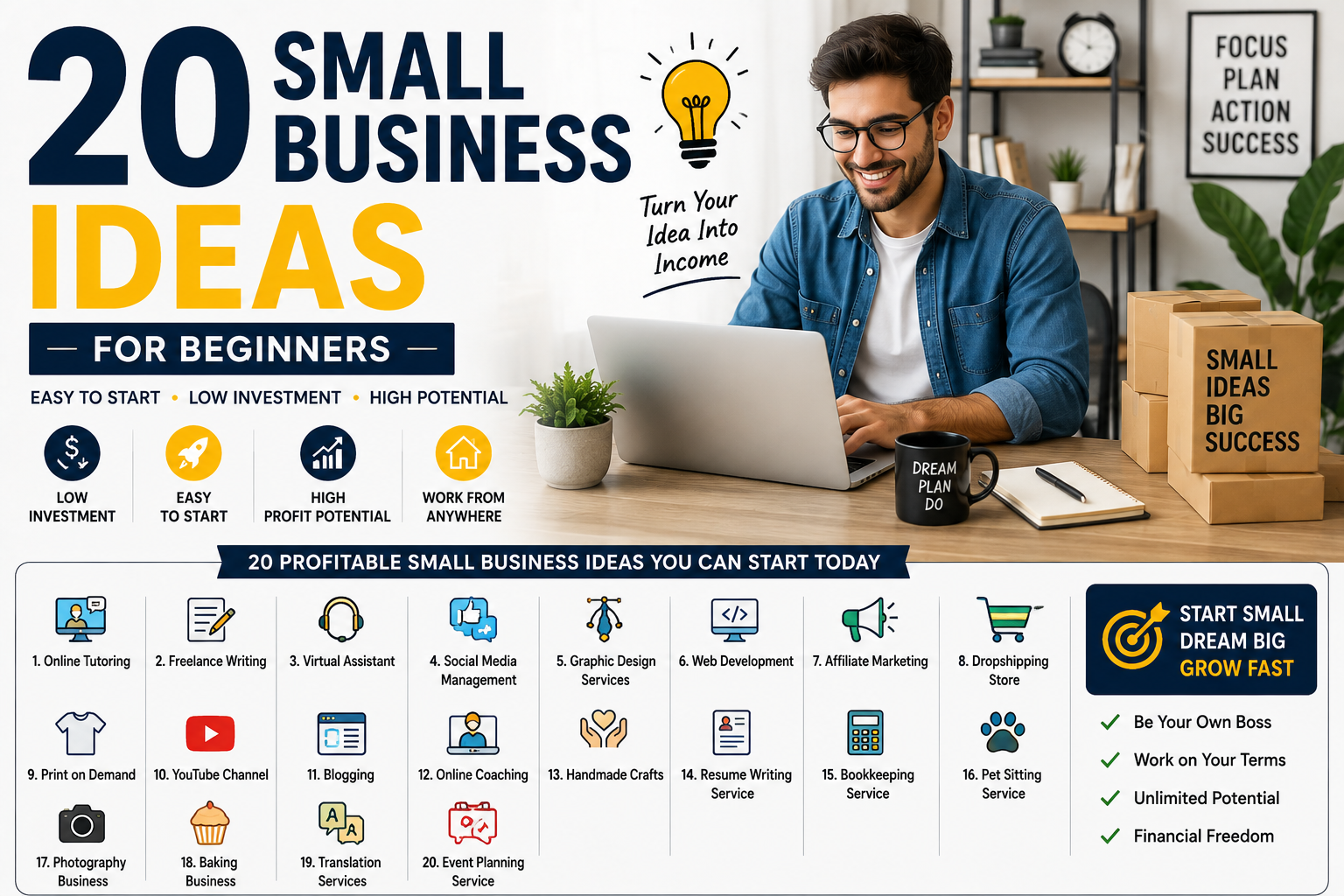
This guide walks you through 20 proven business ideas perfect for beginners. Each one has been started successfully by people with zero business background. We’ll break down realistic costs, required skills, income potential, and specific first steps. Whether you have $50 or $5,000, two hours weekly or full-time availability, there’s a viable option here.
The goal isn’t just to pick something that sounds interesting. It’s to match your unique combination of skills, resources, and circumstances with a business model that actually works. Let’s find yours.
What Is a Small Business?
A small business is an independently owned and operated company with relatively few employees and modest revenue compared to larger corporations. The U.S. Small Business Administration defines it by industry-specific size standards, but generally, we’re talking about businesses with fewer than 500 employees and revenue under $10 million annually.
For beginners, though, think much smaller. Your first business might be just you, working from home, serving a handful of clients or customers. That’s completely normal and valid.
Key characteristics of small businesses:
- Independent ownership: You control decisions, direction, and profits
- Local or niche focus: Serving specific communities or specialized markets
- Personal service: Direct relationships with customers
- Flexible operations: Ability to adapt quickly to changes
- Limited resources: Operating on tight budgets and lean teams
Benefits of small business ownership:
The advantages go beyond just making money. Small business owners report higher job satisfaction than traditional employees. You control your schedule, choose who you work with, and directly benefit from your efforts. Every improvement you make increases your income, unlike climbing corporate ladders where raises come annually if you’re lucky.
Financial benefits include tax advantages (deducting legitimate business expenses), unlimited income potential (your effort directly impacts earnings), and asset building (businesses can be sold for multiples of annual profit).
Common misconceptions:
Many people delay starting because of false beliefs. You don’t need:
- A revolutionary idea (most successful small businesses solve ordinary problems better)
- Tons of money (many start for under $500)
- A business degree (practical experience matters more)
- Perfect timing (there’s never a “perfect” time)
- Everything figured out (you learn by doing)
The best small businesses often start as side projects. You test the waters while employed, validate the concept with real customers, then scale based on actual demand rather than assumptions.
Why Beginners Should Start a Small Business
Financial Freedom
Traditional employment caps your income. No matter how hard you work, you get the same paycheck. Small business ownership removes that ceiling. Your earning potential directly correlates with value delivered to customers.
While starting a business won’t make you rich overnight, it creates pathways to wealth building impossible in typical jobs. Service businesses can scale to six figures annually. Product businesses can generate passive income while you sleep. Digital assets like blogs or courses can sell indefinitely without additional effort.
Flexible Schedule
Control over your time might be the most underrated benefit. Need to attend your kid’s school event? Go. Want to work early mornings because that’s when you’re sharpest? Do it. Prefer traveling while working remotely? Absolutely possible.
Flexibility doesn’t mean working less—many business owners work harder than they did as employees, especially initially. But you’re working on your own terms, building something that belongs to you.
Low Startup Costs
Previous generations needed substantial capital to open businesses. Storefronts required leases, inventory, and buildouts costing tens of thousands. Today’s service and digital businesses launch for the cost of dinner out.
Freelance writing? You need a computer you already own. Virtual assistance? Same thing. Even product businesses through dropshipping or print-on-demand require no upfront inventory investment.
Low costs mean low risk. Testing a business idea for $200 won’t derail your finances if it doesn’t work. You learn valuable lessons with minimal downside.
Learning Valuable Skills
Running a business forces you to develop capabilities you’d never gain in specialized employment. You’ll learn marketing, sales, customer service, basic accounting, project management, negotiation, and problem-solving.
These skills transfer to every area of life. Even if your business eventually closes, you’ll have competencies that make you more valuable in any future employment or venture.
Long-Term Income Potential
The businesses you start today can grow into significant income sources. A freelance writing side hustle can evolve into a content agency employing other writers. An online store can scale to seven figures. A coaching practice can expand into digital courses reaching thousands.
More importantly, businesses create equity. Employees trade time for money with nothing to show when they stop working. Business owners build assets that can be sold. Even small businesses regularly sell for 2-4 times annual profit, creating substantial paydays.
According to SCORE, approximately 70% of small businesses survive at least two years, and about half make it to five years. With proper planning and persistence, your beginner business can become a long-term income source and asset.
How to Choose the Right Business Idea
Picking the right business dramatically impacts your success odds. Choose something misaligned with your life, and you’ll struggle regardless of how profitable it could be for someone else. Consider these factors carefully:
Assess Your Interests
You don’t need to be passionate about your business, but you shouldn’t hate it either. You’ll spend hundreds of hours on this. If the work makes you miserable, you’ll quit before seeing results.
Ask yourself:
- What topics do I naturally enjoy discussing?
- What problems do I like solving?
- What activities make time fly?
- What would I do even without immediate payment?
Interest provides fuel during difficult early stages when money isn’t flowing yet.
Evaluate Your Skills
Existing skills let you deliver value immediately. Businesses built on what you already know can generate income within weeks instead of months or years.
Consider:
- Professional skills from current/previous jobs
- Technical abilities (writing, design, coding, analysis)
- Soft skills (teaching, organizing, communicating)
- Hobbies you’ve mastered (photography, baking, crafting)
Don’t have obvious skills? That’s fine—many business ideas require abilities you can learn quickly through free online resources.
Determine Your Budget
Be honest about available capital. Include only money you can afford to lose without damaging your financial security.
Budget categories:
- $0-100: Service businesses requiring just your time and skills
- $100-500: Businesses needing basic tools, software, or small equipment
- $500-1,000: Ventures requiring inventory, multiple tools, or paid advertising
- $1,000+: Businesses with equipment, professional services, or substantial inventory needs
Start at the lower end if possible. Prove the concept, then reinvest profits to scale.
Research Market Demand
Your brilliant idea needs paying customers. Before committing, validate that people actually want what you’re offering and will pay for it.
Validation methods:
- Google your service or product (existing businesses indicate demand)
- Check freelance platforms for similar services and their rates
- Browse relevant online communities and note common problems
- Ask potential customers directly if they’d pay for your solution
- Look at competitors’ reviews to identify gaps you could fill
Healthy competition usually signals good demand. It means customers exist and pay for solutions in this space.
Analyze Competition
Study who else serves your potential market. Too much competition can be challenging, but too little might mean no demand exists.
What to research:
- Who are the main competitors?
- What do they charge?
- What do customers complain about in reviews? (Your opportunity!)
- What do they do particularly well? (Learn from it)
- How could you differentiate yourself?
You don’t need to be completely unique. You just need to serve a specific subset of customers better than alternatives.
Consider Profitability
Different businesses have vastly different income potential and timelines to profitability.
Evaluate:
- What can you realistically charge?
- How many customers or sales can you handle?
- What are ongoing costs?
- How long until you see first revenue?
- What’s the realistic income ceiling?
Service businesses often profit quickly but have time-based income limits. Product and digital businesses take longer to build but can scale beyond your personal hours.
Assess Time Commitment
Be realistic about available time. If you’re working full-time, you might have 10-15 hours weekly. Choose businesses compatible with that reality.
Questions:
- How many hours can I dedicate weekly?
- Does this business require specific availability (client calls, deliveries)?
- Can I batch the work (do it all at once weekly)?
- Will busy periods coincide with my availability?
Some businesses demand consistent daily attention. Others can be done entirely on weekends. Match the rhythm to your life.
Think About Scalability
Consider whether you want a lifestyle business generating steady personal income or something that could grow into a larger company.
Scalability factors:
- Can you hire others to do the work?
- Could you automate or systematize processes?
- Is there a large addressable market?
- Could you create passive income streams?
Neither option is better—it depends on your goals. A solo consulting practice generating $100k annually is fantastic if that’s what you want. A scalable e-commerce business that could reach millions is better if you have bigger ambitions.
The intersection:
The ideal business sits at the intersection of what you enjoy, what you’re good at, what people will pay for, and what fits your resources. Perfect alignment is rare. Prioritize what matters most to you—then get started.
20 Small Business Ideas for Beginners
1. Freelance Writing
Overview:
Create written content for businesses, publications, or individuals. Types include blog posts, articles, website copy, email newsletters, white papers, and marketing materials.
Why it’s beginner-friendly:
Writing uses a skill you’ve developed your entire life. No special certifications required. You can start immediately with just a computer and internet connection. Platforms like Upwork and Fiverr provide access to clients actively seeking writers.
Estimated startup cost: $0-$200
- Computer (already own)
- Grammar checking tool like Grammarly (free or $12/month)
- Simple portfolio website (optional: $10-30/month)
Skills required:
- Strong writing ability and grammar
- Research skills
- Ability to adapt tone for different audiences
- Basic understanding of formatting
- Meeting deadlines consistently
Income potential:
- Beginners: $25-75 per article or $0.03-0.10 per word
- With experience: $100-500+ per article or $0.15-1.00+ per word
- Monthly income: $500-5,000+ depending on volume
Pros:
- Extremely low startup costs
- Work from anywhere with internet
- Flexible hours
- Consistent demand across industries
- Build portfolio quickly
Challenges:
- Income fluctuation when starting
- Need to market yourself consistently
- Competitive at basic level
- Some clients pay poorly
- Deadlines can cluster
Quick getting-started tip:
Choose a niche (healthcare, finance, technology, marketing) instead of being a generalist. Create three sample articles in that niche, build a simple portfolio on Contently or WordPress, then apply to 10 jobs daily on Upwork or Fiverr. Pitch your specific expertise rather than generic writing skills.
2. Virtual Assistant
Overview:
Provide remote administrative support to entrepreneurs, executives, or small businesses. Tasks include email management, scheduling, customer service, data entry, social media posting, research, and project coordination.
Why it’s beginner-friendly:
Uses organizational and communication skills most people already have. Clients provide training on their specific needs and tools. Demand is massive as more businesses operate remotely. No specialized education required.
Estimated startup cost: $0-$300
- Computer and internet (have these)
- Communication tools like Zoom (free or $15/month)
- Project management familiarity (free tools available)
- Professional email address (free)
Skills required:
- Strong organizational abilities
- Excellent communication
- Proficiency with basic tools (email, calendar, Microsoft Office/Google Workspace)
- Reliability and discretion
- Quick learning of new software
Income potential:
- Beginners: $15-25/hour
- Experienced VAs: $30-60/hour
- Specialized VAs (bookkeeping, marketing): $50-100/hour
- Monthly income: $1,200-6,000+ with consistent clients
Pros:
- Low entry barrier
- Variety of tasks keeps work interesting
- Build long-term client relationships
- Steady retainer income possible
- Work from home in comfortable clothes
Challenges:
- May require availability during specific hours
- Juggling multiple clients takes organization
- Some clients have unrealistic expectations
- Income directly tied to hours worked
- Building initial client base takes effort
Quick getting-started tip:
Sign up on Belay, Time Etc, or Fancy Hands to start getting matched with clients while you build your own. Offer a specific package like “20 hours monthly support” with clear deliverables. Start with general admin work, then specialize in an area that interests you (social media, bookkeeping, project management) to command higher rates.
3. Graphic Design
Overview:
Create visual content for businesses including logos, branding materials, social media graphics, advertisements, website designs, packaging, infographics, and marketing collateral.
Why it’s beginner-friendly:
Numerous free and affordable design tools make this accessible without expensive software. Online tutorials teach fundamentals quickly. Portfolio matters more than formal education. Businesses of all sizes need design work constantly.
Estimated startup cost: $0-$600
- Computer (already have)
- Design software: Canva Pro ($13/month) or Adobe Creative Cloud ($55/month) or free alternatives (GIMP, Figma)
- Portfolio website (free through Behance or $10-30/month)
Skills required:
- Understanding of design principles (color, typography, layout)
- Software proficiency
- Creativity and visual thinking
- Client communication
- Accepting and incorporating feedback
Income potential:
- Logo design: $100-2,000+
- Social media graphics set: $50-500
- Brand identity package: $500-5,000+
- Hourly rate: $25-150+
- Monthly income: $1,000-10,000+ depending on projects
Pros:
- Creative and fulfilling
- Remote work
- Portfolio-based (degree not required)
- Diverse projects and industries
- Can specialize in niches you enjoy
Challenges:
- Subjective feedback can frustrate
- Software has learning curve
- Competition from cheap platforms
- Revisions extend timelines
- Staying current with design trends
Quick getting-started tip:
Start with Canva to learn design principles without software complexity. Create 5-10 sample designs (mock logos, social posts, flyers) for fictional businesses. Post these on Instagram and Behance. Offer local small businesses free logo redesigns in exchange for testimonials and portfolio pieces. Once you have three real projects, start charging.
4. Social Media Management
Overview:
Manage social media accounts for businesses including content creation, posting schedules, community engagement, responding to messages, analytics reporting, and strategy development across platforms like Instagram, Facebook, LinkedIn, and TikTok.
Why it’s beginner-friendly:
You already use social media personally. Business usage applies familiar skills professionally. Small businesses desperately need help but can’t afford full-time employees. Results are visible and measurable.
Estimated startup cost: $50-$300
- Scheduling tools (Buffer or Later: free to $25/month)
- Canva Pro for graphics ($13/month)
- Analytics tools (many free options)
- Computer and phone (already have)
Skills required:
- Understanding platform algorithms and best practices
- Content creation (writing, basic design)
- Community management and customer service
- Analytics interpretation
- Staying current with trends
Income potential:
- Management per platform: $300-1,500/month per client
- Full management (multiple platforms): $1,000-4,000+/month per client
- Beginners typically start at $500-800/client
- Monthly income: $2,000-10,000+ with 4-8 clients
Pros:
- High demand from small businesses
- Creative work with variety
- Clear results to show clients
- Remote work
- Relatively low barrier to entry
Challenges:
- Requires daily attention and consistency
- Algorithm changes impact strategy
- Clients may have unrealistic growth expectations
- Evenings and weekends often have highest engagement
- Staying ahead of platform changes
Quick getting-started tip:
Grow your own social media presence first to demonstrate competency (even 1,000 genuine followers proves capability). Offer local businesses free one-month management in exchange for a testimonial. Create content batching systems to manage multiple clients efficiently. Focus on 2-3 platforms initially rather than trying to master all.
5. SEO Services
Overview:
Help businesses improve their search engine rankings through keyword research, on-page optimization, content strategy, technical improvements, link building, and local search optimization.
Why it’s beginner-friendly:
Fundamental concepts are learnable through free online resources. Small businesses need help but can’t afford agencies. Results compound over time, making early clients more valuable long-term. You can start with basic services and expand knowledge.
Estimated startup cost: $50-$400
- Learning resources (many free options)
- Basic tools: Ubersuggest or SE Ranking ($30-100/month)
- Google Analytics and Search Console (free)
- Website for portfolio ($10-30/month)
Skills required:
- Understanding of search engine ranking factors
- Keyword research abilities
- On-page optimization knowledge
- Basic technical understanding
- Analytics interpretation
- Content strategy development
Income potential:
- Local business packages: $500-2,000/month
- E-commerce or competitive industries: $2,000-8,000+/month
- One-time audits: $500-3,000
- Monthly income: $2,000-15,000+ depending on clients
Pros:
- High-value service with clear ROI
- Recurring monthly revenue
- Remote work
- Scalable by outsourcing technical work
- Continuous learning keeps it interesting
Challenges:
- Results take 3-6 months (managing expectations)
- Google algorithm updates create uncertainty
- Requires ongoing education
- Competition from offshore providers
- Technical aspects can be complex
Quick getting-started tip:
Learn fundamentals through Moz, Ahrefs Academy, and Google’s own resources (all free). Practice on your own simple website or blog. Start with local businesses (dentists, lawyers, contractors) focusing on local search optimization—easier to show results. Offer free audits to demonstrate value, then propose monthly packages addressing issues you found.
6. Online Tutoring
Overview:
Teach students of any age through video calls. Subjects range from academic topics (math, science, languages, history) to test preparation (SAT, ACT, GRE) to professional skills (coding, Excel, public speaking).
Why it’s beginner-friendly:
If you have knowledge in any subject, you can teach it. No teaching certification required for private tutoring. Flexible scheduling around your availability. Platforms connect you with students immediately.
Estimated startup cost: $0-$200
- Webcam and microphone (built-in works, upgrade costs $50-150)
- Video platform (Zoom free or $15/month)
- Digital whiteboard tool (many free options)
- Reliable internet connection
Skills required:
- Expertise in your subject area
- Patience and clear communication
- Ability to explain concepts multiple ways
- Adaptability to different learning styles
- Basic technology skills
Income potential:
- K-12 tutoring: $20-80/hour
- Test prep (SAT, ACT): $40-150/hour
- College-level subjects: $50-200/hour
- Professional skills: $60-200+/hour
- Monthly income: $1,000-6,000+ depending on hours
Pros:
- Rewarding work seeing students improve
- Flexible scheduling
- No physical materials needed
- Can work from anywhere
- Build loyal client base through referrals
Challenges:
- Income limited by available hours
- Scheduling around students’ availability (often evenings/weekends)
- Summer slowdown for academic subjects
- Need consistent reliability
- Some subjects face heavy platform competition
Quick getting-started tip:
Sign up for platforms like Wyzant, Tutor.com, or VIPKid to get started immediately while building your own client base. Specialize in subjects you genuinely enjoy and know deeply. Offer first session free or half-price to attract students. Create structured lesson plans for common topics so you’re not starting from scratch each time. Ask parents for referrals and reviews after students show improvement.
7. Print-on-Demand Store
Overview:
Sell custom-designed products like t-shirts, mugs, phone cases, wall art, and home decor that are printed and shipped by third-party companies only when customers order. You design and market; they handle production and fulfillment.
Why it’s beginner-friendly:
Zero inventory risk or upfront manufacturing costs. No shipping or fulfillment responsibilities. Easy integration with e-commerce platforms. Test unlimited designs with no financial risk. Creative outlet that can become profitable.
Estimated startup cost: $50-$500
- Design software (Canva free or $13/month)
- E-commerce platform (Etsy free to start, or Shopify $29/month)
- Domain name if using own site ($10-15/year)
- Sample products to verify quality ($50-100)
Skills required:
- Graphic design or illustration
- Understanding of target markets and trends
- Basic marketing
- E-commerce platform navigation
- Customer service
Income potential:
- Profit per item: $3-20 depending on product and markup
- Beginners: $0-500/month first six months typical
- Established stores: $1,000-10,000+/month
- Success heavily depends on design quality and marketing
Pros:
- No inventory or upfront costs
- Passive income potential once set up
- Creative expression
- Easy to test multiple designs and products
- Scalable without additional time investment
Challenges:
- Quality control handled by third party
- Profit margins can be thin (30-40% typical)
- Very competitive marketplace
- Marketing required to stand out
- Need continuous design creation
Quick getting-started tip:
Use Printful or Printify integrated with Etsy to start (easier than standalone store). Research trending niches on Etsy and Amazon. Create 15-20 designs before launching—enough variety to test what sells. Start with one product type (t-shirts) to master it before expanding. Use Pinterest and Instagram to drive traffic. Analyze bestsellers and create variations of successful designs.
8. Dropshipping Business
Overview:
Run an online store selling products you don’t physically stock. When customers order from your website, you purchase items from suppliers who ship directly to customers. You handle marketing, customer service, and branding.
Why it’s beginner-friendly:
No inventory means low financial risk. Test products quickly without commitment. Established platforms (Shopify) and apps (Oberlo, DSers) simplify technical aspects. Learn e-commerce without traditional barriers.
Estimated startup cost: $300-$2,000
- E-commerce platform (Shopify $29-299/month)
- Domain name ($10-15/year)
- Apps and plugins ($20-100/month)
- Product samples ($100-300)
- Initial advertising budget ($500-1,000)
Skills required:
- Product research
- E-commerce platform management
- Digital marketing (especially Facebook/Google ads)
- Customer service
- Supplier communication
- Basic website customization
Income potential:
- Profit margins: 15-45% typical
- Beginners often lose money initially learning advertising
- Successful stores: $2,000-20,000+/month profit
- Highly variable based on products and marketing effectiveness
Pros:
- Low startup costs compared to traditional retail
- No inventory management
- Test products quickly
- Location independent
- Scalable once profitable
Challenges:
- Slim profit margins
- Reliant on suppliers for quality and shipping
- High competition
- Customer service challenges from shipping delays
- Requires understanding of paid advertising
- Many fail due to poor product selection
Quick getting-started tip:
Don’t start with a general store selling random items. Choose a specific niche (hiking gear, pet products, kitchen gadgets for small spaces). Use Oberlo or AliExpress to find products, but order samples before selling to customers. Start with organic social media marketing before paid ads to validate demand. Focus obsessively on customer service to combat dropshipping’s poor reputation.
9. Affiliate Marketing
Overview:
Promote other companies’ products or services through unique referral links on your blog, YouTube channel, social media, or email list. Earn commissions when people purchase through your links.
Why it’s beginner-friendly:
No product creation, inventory, customer service, or fulfillment. Start promoting immediately after joining programs. Learn marketing by doing. Scale with content that works 24/7. Many successful affiliates started with zero marketing knowledge.
Estimated startup cost: $50-$500
- Website and hosting ($50-150/year for basic WordPress site)
- Email marketing tool ($0-30/month)
- Content creation tools ($0-50/month)
- Optional: paid traffic to test ($100-500)
Skills required:
- Content creation (writing, video, or social media)
- Understanding your audience’s needs
- Basic marketing and persuasion
- Patience and consistency
- Analytics to track what works
Income potential:
- Extremely variable: $0-100,000+/month
- First 6-12 months: $0-500/month typical for beginners
- Established affiliate marketers: $2,000-50,000+/month
- Passive income potential after content is created
Pros:
- No customer service or product handling
- True passive income potential
- Unlimited income ceiling
- Work from anywhere
- Multiple income streams from various programs
Challenges:
- Takes 6-12+ months to see meaningful income
- Requires consistent content creation
- Algorithm changes impact traffic
- Commission structures can change
- Very competitive in popular niches
Quick getting-started tip:
Choose a niche you’re genuinely knowledgeable about (fitness, personal finance, parenting, technology). Start a blog or YouTube channel creating genuinely helpful content solving real problems. Join Amazon Associates and ShareASale to access thousands of products. Focus on building audience trust before promoting products. Create content around product comparisons, reviews, and tutorials rather than direct selling.
10. Blogging
Overview:
Create a content-focused website on a specific topic or niche. Monetize through display advertising, affiliate marketing, sponsored content, digital products, or services once you build traffic.
Why it’s beginner-friendly:
Minimal startup costs. Use free resources to learn. Content creation forces you to develop marketing skills. Low risk way to build online asset. Many successful bloggers had zero technical or writing background.
Estimated startup cost: $50-$300
- Web hosting ($3-10/month)
- Domain name ($10-15/year)
- WordPress theme ($0-60 one-time)
- Email marketing ($0-30/month)
- Basic tools and plugins (mostly free)
Skills required:
- Writing ability (improves with practice)
- Basic understanding of your niche topic
- Consistency and patience
- Willingness to learn marketing
- Basic WordPress skills (easy to learn)
Income potential:
- First year: $0-1,000 typical (very slow start)
- Year 2-3: $500-5,000/month if growing well
- Established blogs: $2,000-100,000+/month
- Income from ads, affiliates, products, services, sponsorships
Pros:
- Low startup costs
- Creative expression and authority building
- Multiple monetization options
- Passive income potential
- Build valuable asset
Challenges:
- Very slow to generate income (12-24+ months)
- Requires consistent content creation (1-2 posts weekly minimum)
- Competitive in most niches
- Algorithm changes can devastate traffic
- Many quit before seeing results
Quick getting-started tip:
Choose a niche at the intersection of your knowledge, passion, and commercial viability (people spend money in this space). Research keywords before writing each post using free tools like Ubersuggest. Commit to publishing consistently for at least 12 months before evaluating success. Build email list from day one—traffic from search can disappear, but email list is yours. Monetize with affiliates before ads (better earnings with modest traffic).
11. YouTube Channel
Overview:
Create video content on topics you’re knowledgeable or passionate about. Monetize through YouTube Partner Program (ads), sponsorships, affiliate marketing, merchandise, or promoting your own products and services.
Why it’s beginner-friendly:
Smartphone camera sufficient to start. Free editing software available. YouTube’s algorithm can promote content to new audiences. Learn by creating and analyzing what works. No credentials required—just provide value.
Estimated startup cost: $0-$800
- Smartphone camera (already have) or dedicated camera ($300-600)
- Microphone ($30-200—audio quality matters more than video)
- Lighting ($30-150)
- Free editing software (DaVinci Resolve, iMovie)
Skills required:
- On-camera comfort or screen recording ability
- Basic video editing
- Storytelling and content structuring
- Consistency and persistence
- Understanding of YouTube algorithm basics
Income potential:
- YouTube ads: $1-10 per 1,000 views (highly variable)
- Channel with 100,000 monthly views: $200-2,000/month from ads alone
- Sponsorships: $500-50,000+ per video based on audience size
- Total potential: $0-100,000+/month depending on size and monetization
Pros:
- Video content highly engaging
- Multiple monetization streams
- Older videos continue generating income
- Build personal brand and authority
- Can repurpose content for other platforms
Challenges:
- Requires 1,000 subscribers and 4,000 watch hours to monetize
- Video production time-intensive
- Need consistency (weekly uploads minimum)
- On-camera work isn’t for everyone
- Algorithm changes affect visibility
Quick getting-started tip:
Study successful channels in your niche—analyze their thumbnails, titles, video structure, and what gets most views. Invest in decent audio first (cheap lapel mic). Create simple but compelling thumbnails using Canva. Post weekly on consistent schedule. First 10-20 videos will likely underperform—use them as practice. Engage with every comment to build community. Focus on providing genuine value, not just chasing views.
12. Bookkeeping Services
Overview:
Manage financial records for small businesses including recording transactions, reconciling accounts, managing accounts payable and receivable, preparing financial reports, and ensuring accuracy for tax purposes.
Why it’s beginner-friendly:
Specific learnable skills rather than innate talent. Small businesses desperately need help. Can start part-time while employed. Cloud-based software enables completely remote work. Certification courses widely available and affordable.
Estimated startup cost: $500-$2,000
- Bookkeeping certification course ($300-1,000)
- Accounting software (QuickBooks $30-200/month, though clients often provide access)
- Professional liability insurance ($300-800/year)
- Computer and internet (already have)
- Simple website ($10-30/month)
Skills required:
- Basic accounting principles
- Attention to detail
- Organization and time management
- QuickBooks or similar software proficiency
- Integrity and discretion
- Clear communication with business owners
Income potential:
- Per client: $300-2,000/month depending on business size and complexity
- Hourly rate: $30-75+
- With 10 clients: $3,000-10,000+/month
- Full-time bookkeepers: $40,000-80,000+/year
Pros:
- Steady recurring income
- High demand from small businesses
- Remote work
- Scalable by hiring other bookkeepers
- Recession-resistant (businesses always need bookkeeping)
Challenges:
- Requires learning specific skills
- Detail-oriented work (errors have consequences)
- Tax season can be intense
- Potential liability if mistakes occur
- May require specific availability during month-end
Quick getting-started tip:
Get AIPB or NACPB certification (demonstrates competency to clients). Master QuickBooks Online thoroughly—it’s the industry standard. Start with very small businesses (freelancers, single-person businesses) to build confidence and portfolio. Join local business networking groups (Chamber of Commerce, BNI) to find clients. Partner with CPAs who can refer clients needing bookkeeping but not full accounting services.
13. Resume Writing
Overview:
Write, edit, format, and optimize resumes, cover letters, LinkedIn profiles, and other career documents for job seekers across industries and experience levels.
Why it’s beginner-friendly:
Leverages writing skills you already have. Quick turnaround (2-3 days typical). Clear deliverables and project scope. Relatively easy to find clients (job seekers actively searching for help). Learn by doing and studying successful examples.
Estimated startup cost: $0-$400
- Microsoft Word or Google Docs (free)
- Resume templates ($0-50)
- Website ($10-30/month)
- Optional: Certified Professional Resume Writer certification ($400-1,000)
Skills required:
- Strong writing and editing
- Understanding of hiring practices and ATS (Applicant Tracking Systems)
- Ability to extract achievements from client conversations
- Marketing copywriting skills
- Knowledge across industries helpful
Income potential:
- Entry-level resume: $100-300
- Professional resume: $300-600
- Executive resume: $600-2,000+
- Additional services (LinkedIn, cover letters): $50-300 each
- Monthly income: $2,000-8,000+ depending on volume
Pros:
- Low startup costs
- Quick project turnaround
- Rewarding when clients land jobs
- Work from anywhere
- Can specialize in industries or career levels
Challenges:
- Clients can be stressed and demanding
- Need to extract information from clients who undersell themselves
- Competitive market
- Income tied to number of projects
- Seasonal fluctuations
Quick getting-started tip:
Study ATS optimization thoroughly—most resumes must pass automated screening. Offer package deals (resume + cover letter + LinkedIn for $400-500). Create templates for different industries to speed up process. Ask every satisfied client for testimonial and LinkedIn recommendation. Specialize in specific career levels (entry-level, mid-career, executives) or industries (healthcare, technology, education) to stand out.
14. Online Coaching
Overview:
Provide one-on-one or small group coaching in your area of expertise via video calls. Niches include business coaching, career coaching, health and fitness, life coaching, relationship coaching, or specialized skills.
Why it’s beginner-friendly:
Leverage knowledge you already have. Low startup costs. Flexible scheduling. No special equipment needed. High perceived value allows premium pricing. Start with just one client while employed.
Estimated startup cost: $0-$500
- Video conferencing (Zoom free or $15/month)
- Scheduling software (Calendly free or $8/month)
- Simple website ($10-30/month)
- Optional certification in your coaching specialty ($300-5,000)
Skills required:
- Expertise in your coaching area
- Active listening and questioning
- Motivational and supportive approach
- Structured methodology or framework
- Basic business and marketing
Income potential:
- Session rate: $75-500+ per session
- Package deals: $1,000-10,000+ for multi-session programs
- Group coaching: $100-500 per person monthly
- Monthly income: $3,000-30,000+ depending on clients and pricing
Pros:
- High earning potential per hour
- Deeply rewarding work
- Flexible schedule
- Low overhead
- Build authority and reputation
Challenges:
- Income tied to available hours (until you scale)
- Requires continuous client acquisition
- Emotional labor can be draining
- Results depend partly on client follow-through
- Some niches highly competitive
Quick getting-started tip:
Choose specific niche rather than general coaching (career transition for mid-level professionals, not just “career coaching”). Get relevant certification if it adds credibility in your niche. Offer free discovery calls to attract clients and assess fit. Create structured program rather than open-ended sessions. Collect powerful testimonials and case studies. Use content marketing (blog, YouTube, LinkedIn) to demonstrate expertise and attract ideal clients.
15. Handmade Crafts Business
Overview:
Create and sell handmade items like jewelry, candles, soaps, pottery, knitwear, woodworking, leather goods, or home decor through online platforms (Etsy, Amazon Handmade), local markets, or your own website.
Why it’s beginner-friendly:
Start with skills and hobbies you already enjoy. Test products at local craft fairs before investing heavily. Build inventory gradually. Creative outlet that can become profitable. Customers increasingly value handmade and unique items.
Estimated startup cost: $200-$2,000
- Materials and supplies ($150-1,000)
- Basic tools ($100-1,000 depending on craft)
- Etsy account ($0.20 per listing)
- Packaging supplies ($50-200)
- Photography setup ($30-200)
Skills required:
- Craft-specific skills (varies by product)
- Product photography
- Basic business operations
- Pricing and cost calculation
- Customer service
- Marketing through social media
Income potential:
- Per item: $10-500+ depending on product
- Profit margins: 40-70% after materials
- Beginners: $300-1,500/month
- Established makers: $2,000-10,000+/month
- Some makers reach six figures annually
Pros:
- Creative and fulfilling
- Turn hobby into income
- Control entire process and brand
- Multiple sales channels
- Flexible production schedule
Challenges:
- Time-intensive production limits scalability
- Material costs fluctuate
- Seasonal sales patterns (busy before holidays)
- Easy to underprice
- Shipping costs eat into margins
Quick getting-started tip:
Start with one product you can make consistently at quality level. Calculate true costs (materials, time at reasonable hourly rate, platform fees, shipping) before pricing. Take photos in natural light with clean backgrounds. Test at local craft fairs to get immediate feedback. Build social media presence showing your creation process—people love behind-the-scenes. Consider teaching workshops as additional income stream.
16. Pet Sitting Business
Overview:
Care for pets in their homes while owners travel or work. Services include dog walking, drop-in visits, overnight sitting, and basic pet care. Coordinate through platforms like Rover or build your own client base.
Why it’s beginner-friendly:
Love of animals is main requirement. Low startup costs. Flexible scheduling. Build local client base through word-of-mouth. No special education needed (though pet first aid helpful). Start with one or two clients before scaling.
Estimated startup cost: $100-$600
- Pet sitting insurance ($200-400/year)
- Background check ($30-100)
- Pet first aid certification ($50-100)
- Business cards and marketing ($50-100)
- Supplies (leashes, waste bags, cleaning): $50-100
Skills required:
- Genuine love and understanding of animal behavior
- Reliability and trustworthiness
- Physical ability to handle pets
- Communication with pet owners
- Time management
- Basic pet care knowledge
Income potential:
- Dog walking: $15-35 per 30-minute walk
- Drop-in visits: $25-50 per visit
- Overnight sitting: $50-150 per night
- Monthly income: $1,500-6,000+ depending on volume
- Can scale by hiring other sitters
Pros:
- Work with animals daily
- Flexible schedule
- Exercise included in job
- Build loyal local client base
- Relatively easy to start
Challenges:
- Geographic limitations
- Requires availability during holidays (peak demand)
- Weather affects dog walking
- Liability if pet injured
- Need reliable transportation
Quick getting-started tip:
Start on Rover or Wag to build initial client base and reviews while establishing your own business. Get pet first aid certified and liability insurance before first client. Create detailed service agreement covering emergencies, vet authorization, and expectations. Ask every satisfied client for referrals and Google reviews. Partner with local vets, groomers, and pet stores for referrals. Specialize in specific pets (cats only, large dogs, exotic pets) to stand out.
17. Photography Business
Overview:
Provide photography services for portraits, events, products, real estate, or stock photography. Work ranges from one-time sessions to ongoing client relationships with businesses.
Why it’s beginner-friendly:
Smartphone cameras now rival basic professional cameras. Free editing software available. Portfolio matters more than formal education. Can start part-time shooting friends and family. Immediate income from first paying client.
Estimated startup cost: $500-$3,000
- Camera and basic lens ($400-2,000)
- Lighting equipment ($100-500)
- Editing software (Lightroom/Photoshop $10-55/month, or free alternatives)
- Website/portfolio ($10-40/month)
- Business cards and marketing ($50-100)
Skills required:
- Photography fundamentals (lighting, composition, exposure)
- Photo editing
- Client communication and directing
- Business and marketing
- Specific knowledge for your niche (posing for portraits, angles for real estate)
Income potential:
- Portrait sessions: $150-1,000+
- Events (weddings): $1,500-10,000+
- Real estate: $100-500 per property
- Product photography: $100-500+ per product
- Monthly income: $1,000-10,000+ depending on bookings
Pros:
- Creative work
- Immediate income from sessions
- Meet diverse people
- Multiple specialization options
- Build portfolio with each job
Challenges:
- Equipment investment required
- Competitive local markets
- Weekends and evenings often required for sessions
- Editing time-consuming
- Seasonal demand fluctuations
Quick getting-started tip:
Choose a niche (family portraits, newborn, real estate, product, pets, events) rather than being generalist. Offer mini-sessions to build portfolio (30-minute shoots at reduced rate). Invest in a quality lens before upgrading camera body. Master your editing style for consistency. Use Instagram heavily for marketing. Deliver photos quickly (within a week) for positive reviews. Network with complementary businesses (wedding planners, realtors, small business owners).
18. Cleaning Business
Overview:
Provide residential or commercial cleaning services. Types include regular home cleaning, deep cleaning, move-in/move-out cleaning, office cleaning, or specialized services (post-construction, window washing).
Why it’s beginner-friendly:
Everyone knows how to clean. Low startup costs for basic supplies. Immediate local demand. Cash flow positive from first client. Simple to understand and explain. Can start solo and scale by hiring cleaners.
Estimated startup cost: $200-$1,000
- Cleaning supplies and equipment ($150-500)
- Insurance ($300-600/year)
- Transportation costs (use personal vehicle)
- Marketing materials ($50-150)
- Business license ($50-200)
Skills required:
- Thorough cleaning abilities
- Physical stamina
- Attention to detail
- Time management (estimating job duration)
- Customer service
- Reliability and trustworthiness
Income potential:
- Residential cleaning: $100-250 per home (2-4 hours)
- Hourly rate: $25-50+ per hour
- Commercial contracts: $500-5,000+/month
- Monthly income solo: $2,000-5,000+
- With employees: $5,000-20,000+ monthly
Pros:
- Low barrier to entry
- Steady demand (people always need cleaning)
- Cash flow positive immediately
- Flexible scheduling
- Scalable by hiring team
Challenges:
- Physically demanding work
- Need reliable transportation
- Liability if something breaks
- High client expectations
- Competition from established companies
Quick getting-started tip:
Start with residential cleaning before commercial (easier to get started). Offer first-time cleaning discount to build client base. Get liability insurance before first job. Create clear pricing structure (per square foot or per room). Ask every satisfied client for referrals and reviews. Focus on reliability and consistency—show up on time, every time. Once you have 10-15 regular clients, hire helper to start scaling.
19. Mobile Car Wash
Overview:
Provide car washing and detailing services at customers’ locations—homes, offices, or parking lots. Services range from basic exterior wash to full interior and exterior detailing.
Why it’s beginner-friendly:
Low startup costs for basic equipment. Convenience factor makes customers willing to pay premium over traditional car washes. Immediate cash flow. Simple service to understand and deliver. Flexible scheduling around other commitments.
Estimated startup cost: $500-$2,000
- Pressure washer or waterless system ($200-600)
- Cleaning supplies (soap, wax, towels, brushes): $150-400
- Generator if needed ($300-600)
- Vehicle signage ($100-300)
- Insurance ($300-600/year)
- Water tank if no water access ($100-500)
Skills required:
- Car washing and detailing techniques
- Customer service
- Time management
- Physical stamina
- Basic marketing
- Reliable transportation
Income potential:
- Basic wash: $25-50
- Full detail: $100-300+
- Per day (4-6 cars): $150-500
- Monthly income: $2,000-8,000+
- Can scale by hiring workers and multiple vehicles
Pros:
- Low startup costs
- Cash business (paid immediately)
- Flexible schedule
- Outdoor work
- High profit margins (70%+)
Challenges:
- Weather dependent
- Physically demanding
- Need water access or tank system
- Slow during winter in cold climates
- Building initial client base takes effort
Quick getting-started tip:
Start with waterless wash products to eliminate water access requirement. Offer subscription packages (weekly or monthly service) for predictable income. Target office parking lots and apartment complexes for multiple cars in one location. Create Yelp and Google Business listings. Distribute flyers in neighborhoods with nice cars. Invest in quality microfiber towels and products—quality results get referrals.
20. Digital Marketing Agency
Overview:
Offer multiple digital marketing services to businesses including social media management, content creation, advertising management, email marketing, branding, and strategy. Start as solo practitioner and scale by outsourcing specialized work.
Why it’s beginner-friendly:
Can start by offering one service you know (social media) and expand. Businesses desperately need marketing help. Learn by working with real clients. Outsource technical work you can’t do yet. High demand with recurring revenue potential.
Estimated startup cost: $200-$1,000
- Website ($20-50/month)
- Basic tools and software ($50-150/month)
- Business cards and marketing ($50-200)
- Legal structure setup ($50-500)
Skills required:
- Marketing fundamentals
- One specialized skill to start (social media, content, ads)
- Client communication and project management
- Business operations
- Willingness to learn continuously
Income potential:
- Per client retainer: $1,000-10,000+/month
- Project-based work: $2,000-50,000+
- Starting agencies: $3,000-10,000/month
- Established agencies: $20,000-200,000+/month
- Highly scalable by building team
Pros:
- Multiple service offerings
- High income potential
- Recurring revenue model
- Scalable through team building
- Work with diverse clients and industries
Challenges:
- Requires multiple skill sets or outsourcing
- Client management complexity
- Results-focused (clients expect ROI)
- Competitive market
- Building reputation takes time
Quick getting-started tip:
Don’t try to offer everything immediately. Start with one core service you’re competent in (social media management, content creation, Facebook ads). Land first 2-3 clients at reduced rates to build portfolio. Outsource specialized work through Upwork or Fiverr initially. Add services as you learn them or find reliable contractors. Package services together (social media + content creation + email marketing) for higher monthly retainers. Focus on specific industries to develop expertise.
Best Business Ideas by Budget
| Budget | Recommended Business Ideas | Estimated Timeline to First Income | Income Potential |
|---|---|---|---|
| Under $100 | • Freelance Writing<br>• Virtual Assistant<br>• Online Tutoring<br>• Resume Writing<br>• Social Media Management | 1-4 weeks | $500-5,000/month |
| Under $500 | • Graphic Design<br>• Bookkeeping Services<br>• Affiliate Marketing<br>• Blogging<br>• Online Coaching | 1-8 weeks | $1,000-8,000/month |
| Under $1,000 | • Photography<br>• Print-on-Demand<br>• YouTube Channel<br>• Pet Sitting<br>• Mobile Car Wash | 2-12 weeks | $1,000-10,000/month |
| Above $1,000 | • Dropshipping<br>• Cleaning Business<br>• Handmade Crafts<br>• Digital Marketing Agency | 4-16 weeks | $2,000-20,000+/month |
Key factors affecting income:
- Time invested weekly
- Marketing effectiveness
- Service quality and reliability
- Local market conditions (for location-based businesses)
- Learning curve and prior experience
Essential Tools Every Beginner Needs
Accounting and Invoicing
Wave (Free)
- Perfect for freelancers and small businesses
- Invoicing, expense tracking, receipt scanning
- Basic accounting reports
- Bank connection for automatic categorization
QuickBooks Self-Employed ($15/month)
- Mileage tracking
- Expense categorization
- Quarterly estimated tax calculations
- Schedule C preparation
FreshBooks ($17-55/month)
- Professional invoicing
- Time tracking
- Expense management
- Client communication portal
Marketing and Design
Canva (Free or $13/month Pro)
- Social media graphics
- Marketing materials
- Presentations
- Thousands of templates
Mailchimp (Free up to 500 contacts)
- Email marketing
- Basic automation
- Simple landing pages
- Audience management
Buffer (Free or $6/month)
- Social media scheduling
- Multi-platform posting
- Basic analytics
- Content calendar
Email and Communication
Gmail/Google Workspace (Free or $6/user/month)
- Professional email
- Calendar
- Google Drive storage
- Video calls through Meet
Zoom (Free or $15/month)
- Video conferencing
- Screen sharing
- Recording capability
- Up to 100 participants
Project Management
Trello (Free or $10/user/month)
- Visual task boards
- Simple organization
- Team collaboration
- Mobile apps
Asana (Free or $11/user/month)
- Task and project tracking
- Multiple views (list, board, calendar)
- Team assignments
- Deadline tracking
ClickUp (Free or $9/user/month)
- All-in-one workspace
- Tasks, docs, goals, chat
- Highly customizable
- Generous free plan
Website and Online Presence
WordPress.org (Free software + hosting $3-10/month)
- Most flexible platform
- Thousands of themes and plugins
- Full control
- Scalable from blog to complex site
Wix ($16-45/month)
- Drag-and-drop builder
- Beautiful templates
- All-in-one hosting
- Good for beginners
Google Business Profile (Free)
- Essential for local businesses
- Appear in Google Maps
- Collect reviews
- Post updates
Payment Processing
PayPal (Free + 2.9% + $0.30 per transaction)
- Easy setup
- Widely recognized
- Invoice creation
- International payments
Stripe (Free + 2.9% + $0.30 per transaction)
- Professional payment processing
- Subscription billing
- Developer-friendly
- Multiple payment methods
Square (Free + 2.6% + $0.10 in-person, 2.9% + $0.30 online)
- Point of sale
- Online payments
- Invoicing
- In-person card reader
Time Tracking
Toggl Track (Free or $10/user/month)
- Simple time tracking
- Project organization
- Reporting
- Idle detection
Clockify (Free)
- Unlimited users and projects
- Time tracking
- Reporting
- Team management
File Storage and Backup
Google Drive (15GB free, $2-10/month for more)
- Cloud storage
- Real-time collaboration
- Integrated with Google Workspace
- Accessible anywhere
Dropbox (2GB free, $12/month for more)
- Reliable syncing
- File sharing
- Simple interface
- Automatic backup
Recommended Starter Stack (Total: $20-50/month):
- Accounting: Wave (free)
- Email: Gmail (free) or Google Workspace ($6)
- Design: Canva Free
- Project management: Trello Free
- Video calls: Zoom Free
- Website: WordPress + basic hosting ($10)
- Payment: PayPal (free + fees)
- Social media: Buffer Free
Upgrade tools as revenue justifies the investment. Start free/cheap, scale as you grow.
Common Mistakes Beginners Should Avoid
1. Choosing the Wrong Niche
The mistake: Picking a business idea because it’s trendy or seems profitable, not because it fits your skills, interests, or market knowledge.
Why it’s problematic: You’ll compete against people genuinely passionate and knowledgeable. Lack of authentic interest makes content and marketing feel forced. You quit when initial enthusiasm fades.
The solution: Choose at the intersection of what you know, what you enjoy enough to do consistently, and what people actually pay for. Boring but sustainable beats exciting but mismatched.
2. Not Researching the Market
The mistake: Assuming your brilliant idea will automatically attract customers without validating demand or understanding competition.
Why it’s problematic: You waste time and money building something nobody wants. Discover too late that market is oversaturated or doesn’t exist. Price incorrectly because you don’t know market rates.
The solution: Before investing significantly, talk to potential customers. Research competitors’ pricing, reviews, and positioning. Use Google Trends to see if interest is growing or declining. Start small and test before going all-in.
3. Underpricing Services
The mistake: Charging too little because you’re “new” or fear losing clients to cheaper competitors.
Why it’s problematic: Can’t cover expenses or pay yourself fairly. Attracts price-focused clients (not value-focused). Creates unsustainable business model. Signals low quality to many customers. Nearly impossible to significantly raise prices later.
The solution: Research market rates thoroughly. Calculate your costs (time, materials, overhead, taxes). Price based on value provided. Start slightly below market if needed, but not drastically. Raise prices as you gain experience and testimonials. Remember: clients who choose solely on price are often the most difficult.
4. Ignoring Marketing
The mistake: Building great products or services but doing nothing to attract customers. Believing “if you build it, they will come.”
Why it’s problematic: Nobody knows you exist. Competitors who market aggressively win even with inferior offerings. Delays or prevents profitability. Leads to discouragement and quitting.
The solution: Dedicate 30-40% of initial time to marketing. Choose 2-3 channels (social media, networking, content creation, cold outreach) and be consistent. Start marketing before you’re “ready.” Build email list from day one. Create valuable content demonstrating expertise. Ask every satisfied customer for referrals.
5. Mixing Personal and Business Finances
The mistake: Using personal accounts for business transactions, mixing money, and not tracking business finances separately.
Why it’s problematic: Impossible to track true business profitability. Tax preparation becomes nightmare. Looks unprofessional to clients. Creates legal issues with business structures. Can’t prove business expenses if audited.
The solution: Open separate business checking account immediately (even as sole proprietor). Get business credit card for expenses. Use accounting software from day one. Pay yourself defined “salary” rather than random withdrawals. Track every business expense with receipts.
6. Giving Up Too Early
The mistake: Quitting after 2-3 months when results aren’t immediate or when facing first obstacles.
Why it’s problematic: Most businesses take 6-12 months to gain real traction. You quit right before potential breakthrough. Never give business a fair chance. Pattern of starting and stopping prevents any success.
The solution: Set realistic expectations—12-24 months to build sustainable business. Commit to minimum viable effort for at least a year. Track small wins and progress, not just revenue. Connect with other entrepreneurs for perspective. Adjust strategy but don’t quit entirely. Remember: Most successful businesses looked like failures in the early months.
7. Trying to Do Everything Yourself
The mistake: Refusing to outsource, get help, or use tools because you want to save money or keep total control.
Why it’s problematic: Limits growth to your available hours. Stuck doing tasks you’re terrible at. Prevents focusing on highest-value activities. Creates bottlenecks. Leads to burnout.
The solution: Calculate your effective hourly rate. Outsource anything that costs less than that rate. Use automation tools for repetitive tasks. Hire virtual assistants for administrative work when revenue justifies it. Focus your time on activities only you can do or that generate most value.
8. No Written Systems or Processes
The mistake: Operating entirely from memory, reinventing processes each time, keeping everything in your head.
Why it’s problematic: Wastes time redoing same thinking. Makes delegation impossible. Creates inconsistent customer experience. Business completely dependent on you. Difficult to scale or eventually sell.
The solution: Document how you do key tasks (client onboarding, project completion, invoicing). Create templates for common communications. Build checklists for recurring processes. Store everything in accessible location (Google Drive, Notion). Start simple—even bullet point processes help.
9. Neglecting Existing Customers
The mistake: Constantly chasing new customers while ignoring people who already bought from you.
Why it’s problematic: Acquiring new customers costs 5-25 times more than retaining existing ones. Existing customers already trust you. They’re more likely to buy again and refer others. High churn rate makes growth impossible.
The solution: Provide exceptional service to every customer. Follow up after projects complete. Send occasional value-add communications (not just sales pitches). Create referral program. Make repeat purchases easy. Show appreciation for loyalty. Measure customer retention, not just acquisition.
10. Ignoring Cash Flow
The mistake: Focusing solely on revenue while ignoring actual cash in bank, when bills are due, and payment timing.
Why it’s problematic: Can be “profitable” on paper but run out of money. Late client payments create cash crunches. Surprise expenses derail operations. Forces desperate discounting or bad financial decisions.
The solution: Track cash flow separately from profit. Maintain cash reserve (ideally 3-6 months expenses). Invoice promptly and follow up on late payments. Understand your cash conversion cycle. Set payment terms that work for your cash needs. Use accounting software showing cash position, not just profit/loss.
Expert Tips to Grow Faster
Finding First Customers
Leverage your existing network first. Tell everyone you know about your business. Former colleagues, friends, family, social media connections—someone needs your service or knows someone who does. Don’t be shy. Most people want to support new ventures.
Offer irresistible introductory deals. First clients are worth more than their immediate payment—they provide testimonials, portfolio pieces, and experience. Offer first-time discounts (30-50% off) or free strategy sessions to reduce risk for early adopters.
Use platforms strategically. Freelance platforms (Upwork, Fiverr), local service apps (Thumbtack, TaskRabbit), and marketplace sites (Etsy, eBay) provide immediate access to customers actively searching. Yes, they take fees, but they solve the “where are the customers?” problem while you build your own channels.
Create before you’re ready. Start creating content (blog posts, social media, videos) demonstrating your expertise before you’re “official.” People hire experts, and consistent valuable content positions you as one. Your third blog post might land your first client.
Building Trust
Collect social proof obsessively. Ask every satisfied customer for a testimonial, review, or LinkedIn recommendation. Display these prominently on your website and marketing. New customers trust other customers more than your claims.
Be transparent about your process. Explain how you work, what clients can expect, timelines, and deliverables upfront. Mystery creates anxiety. Clarity builds trust.
Deliver more than promised. Under-promise and over-deliver consistently. Finish projects early. Include small unexpected bonuses. Communicate proactively. Exceeded expectations create raving fans who refer others.
Admit what you don’t know. Faking expertise destroys trust when exposed. Honesty about limitations while showing willingness to learn or bring in specialists actually builds credibility.
Creating a Professional Brand
Invest in decent visual identity. You don’t need expensive branding initially, but avoid looking amateur. Use Canva templates for consistent colors and fonts across all materials. Get a proper logo (even from Fiverr for $50) rather than using clip art.
Write like a professional. Check spelling and grammar in all communications. Use clear, confident language. Avoid excessive exclamation points or emoji in business contexts. Your writing represents your professionalism.
Have professional online presence. At minimum: professional email address (yourname@yourbusiness.com, not hotmail/yahoo), complete LinkedIn profile, simple website or landing page. These take hours but dramatically impact perceived legitimacy.
Be consistent across platforms. Use the same business name, profile photo, bio, and messaging everywhere. Consistency builds recognition and trust.
Using Social Media Effectively
Choose the right platform for your audience. B2B services? LinkedIn. Visual products? Instagram and Pinterest. Older demographics? Facebook. Don’t try to be everywhere—master 1-2 platforms where your customers actually are.
Provide value before asking for sales. Follow the 80/20 rule: 80% valuable, educational, or entertaining content; 20% promotional. People follow accounts that help them, not advertise constantly.
Engage authentically. Respond to comments and messages. Join conversations in your niche. Support others’ content. Social media is social—relationships drive results, not broadcasting.
Post consistently. Algorithm rewards regular posting. Create content in batches to maintain consistency. Even 3 times weekly beats sporadic daily posting followed by weeks of silence.
Managing Cash Flow
Invoice immediately. Send invoices the moment work is complete or at predetermined milestones. Delays in invoicing mean delays in payment.
Set clear payment terms. Specify due dates (Net 15 or Net 30). Include late fees in terms (even if you don’t enforce them, they encourage on-time payment). Consider requiring deposits for new clients or large projects.
Follow up on late payments professionally. Send friendly reminder at due date, firmer reminder at 7 days past due, final notice at 14 days. Most late payments are forgetfulness, not malice.
Build cash reserve. Save during good months to cover slow periods. Target 3-6 months of expenses in reserve. This cushion prevents panic during normal business fluctuations.
Understand your cash conversion cycle. Track how long from doing work until you receive payment. Long cycles mean you’re funding operations with your cash. Strategies: require deposits, offer small discounts for early payment, tighten payment terms.
Reinvesting Profits
Pay yourself first, then reinvest strategically. Don’t sacrifice your personal financial health for business growth. Take a reasonable salary or draw, then allocate a portion of remaining profits to growth investments.
Invest in education. Courses, books, coaching, or conferences that improve your skills or business operations often provide highest ROI. Knowledge compounds.
Upgrade tools that create efficiency. Software, equipment, or automation that saves significant time or improves quality pays for itself quickly. Calculate the time saved × your hourly value.
Hire for tasks below your pay grade. Once you’re earning $50/hour doing your core work, hiring someone at $20/hour to handle administrative tasks creates immediate ROI.
Test marketing before scaling it. Start with small ad budgets ($10-20/day) to find what works. Only increase spending once you’ve validated channels that profitably acquire customers.
According to research from SCORE, businesses that work with mentors or advisors are 5 times more likely to survive beyond five years. Seek guidance from those ahead of you—it’s one of the best investments you can make.
Frequently Asked Questions (FAQs)
Can I start a business with no money?
Yes. Service-based businesses like freelance writing, virtual assistance, consulting, tutoring, and social media management require essentially zero capital—just your skills and time. You can literally start today with a free email account and social media profiles. Product businesses and those requiring specialized equipment need some investment, but many service businesses don’t.
How long does it take to make money from a small business?
This varies dramatically by business type. Service businesses (freelancing, VA work, tutoring) can generate income within 1-4 weeks if you actively pursue clients. E-commerce typically takes 1-6 months. Content-based businesses (blogging, YouTube) often take 6-24 months. The timeline depends more on your marketing efforts and market demand than the business itself.
Do I need a business license to start?
Requirements vary by location and business type. Most areas require at least a general business license or permit. Check with your city or county clerk’s office. Service businesses often have simpler requirements than product-based businesses. You can often start as a sole proprietor while researching formal requirements, but don’t ignore them indefinitely—operating without proper licenses can result in fines.
Should I quit my job to start a business?
Generally, no—not immediately. Start your business as a side project while employed. This reduces financial pressure, lets you validate the concept with real customers, and provides income while building. Consider quitting only when business income consistently covers your expenses for 3-6 months and shows growth trajectory. Exception: If you have substantial savings (12+ months expenses), the risk decreases.
What’s the easiest business for a complete beginner?
Easiest usually means leveraging skills you already have with minimal startup costs. Top candidates: virtual assistant (uses organizational skills), freelance writing (uses writing ability), online tutoring (uses knowledge you have), or pet sitting (uses love of animals). “Easiest” is personal—choose what aligns with your existing capabilities.
How much can I realistically earn from a small business?
Highly variable. Solo service providers typically earn $30,000-100,000 annually once established. Scalable businesses (e-commerce, agencies, digital products) can reach six or seven figures. First-year realistic expectations: $5,000-30,000 for part-time effort, $20,000-60,000 full-time. Your income depends on pricing, number of clients/customers, and hours worked. Don’t expect to match full-time employment income immediately.
What are the biggest challenges for beginner entrepreneurs?
The top challenges: finding first customers (marketing), pricing appropriately (many start too low), maintaining consistency (giving up too soon), managing time effectively (balancing business and life), and handling financial uncertainty (irregular income). Nearly all beginners struggle with these. Awareness helps you prepare and persist.
Do I need a website to start a business?
Not immediately, but eventually yes. You can start with just social media profiles or profiles on freelance platforms. However, a simple website increases credibility dramatically. Good news: Basic websites cost $10-30 monthly and can be built in hours using Wix, Squarespace, or WordPress. Even a one-page site with your services, contact info, and testimonials helps.
How do I find my first clients?
Start with your existing network—former colleagues, friends, family, social media connections. Join freelance platforms (Upwork, Fiverr) or service apps (Thumbtack, TaskRabbit). Post in local community groups or neighborhood apps (Nextdoor). Create valuable content on social media or a blog. Offer free consultations or discounted introductory services. Ask everyone you know for referrals. First clients rarely come from polished marketing—they come from hustle and relationships.
What if my business idea doesn’t work?
Most businesses require adjustments before finding product-market fit. If something isn’t working after genuine effort (6-12 months), analyze why. Wrong market? Poor positioning? Weak marketing? Sometimes the core idea needs pivoting. Sometimes execution needs improvement. Total failure is rare—most “failures” are actually valuable learning experiences that inform your next, more successful venture. The lessons and skills gained have value regardless.
Conclusion
Starting a small business as a beginner isn’t just possible—it’s more accessible now than any time in history. You don’t need a revolutionary idea, perfect timing, or substantial capital. You need to choose a business model aligned with your skills and resources, start before you feel completely ready, and persist through the inevitable challenges.
The 20 business ideas in this guide represent proven models that real people with no business background have built into sustainable income sources. Some became side hustles generating an extra $500-2,000 monthly. Others grew into six-figure full-time businesses. The outcome depends less on which idea you choose and more on your execution and persistence.
Remember these key principles:
Choose based on fit, not just profitability. The most lucrative business is useless if you hate the work or lack necessary skills. The intersection of what you can do, what you enjoy enough to do consistently, and what people will pay for is your sweet spot.
Start small and lean. Don’t invest everything upfront. Prove the concept with minimal resources, then scale based on actual customer demand rather than assumptions.
Focus on solving real problems for real people. Businesses succeed by creating value, not by having clever ideas. Understand your customers’ pain points and solve them better than alternatives.
Market relentlessly. The best service or product that nobody knows about fails. Average offerings with excellent marketing often beat superior offerings with no marketing.
Be patient but persistent. Most businesses take 6-12 months to gain meaningful traction. Quitting at month three means you never discover if it would have worked. Adjust strategy, but don’t give up at the first obstacle.
Learn continuously. Invest in improving your skills, understanding your market, and refining your systems. Every challenge teaches something valuable if you’re paying attention.
Your next steps:
- Choose 2-3 business ideas from this list that genuinely interest you
- Research each deeper (Google, YouTube, online forums)
- Identify which aligns best with your current skills, available time, and budget
- Take one concrete action this week (sign up for a platform, create portfolio pieces, reach out to a potential client)
- Commit to showing up consistently for at least 90 days
The distance between where you are now and running a successful small business isn’t as far as it seems. It’s measured in consistent daily actions, not giant leaps. Other beginners are doing this successfully right now. You can too.
Stop overthinking. Stop waiting for perfect conditions. Choose a business idea that fits your life. Start small. Learn as you go. Build something that’s yours.
Your entrepreneurial journey starts with a single step. Take it today.
References
- U.S. Small Business Administration. (2024). “Small Business Profile.” SBA.gov. https://www.sba.gov/sites/default/files/advocacy/Small-Business-Profiles-US.pdf
- SCORE. (2024). “Small Business Statistics and Trends.” SCORE.org. https://www.score.org/resource/infographic-small-business-trends
- U.S. Bureau of Labor Statistics. (2024). “Business Employment Dynamics.” U.S. Department of Labor. https://www.bls.gov/bdm/
- Internal Revenue Service. (2024). “Small Business and Self-Employed Tax Center.” IRS.gov. https://www.irs.gov/businesses/small-businesses-self-employed
- Harvard Business Review. (2023). “The Value of Customer Retention.” HBR.org.
- U.S. Census Bureau. (2024). “Statistics of U.S. Businesses.” Census.gov. https://www.census.gov/programs-surveys/susb.html
Business Disclaimer
This article is for informational and educational purposes only. The business ideas, startup costs, earning potential, and strategies discussed are general guidelines and may vary based on market conditions, location, experience, and individual circumstances. Unlocked The Magazine does not guarantee financial success or business outcomes. Always conduct thorough research and seek advice from qualified financial, legal, or business professionals before starting or investing in any business.