

Quick Answer
The best online small business ideas in 2026 include freelance writing, virtual assistant services, dropshipping, affiliate marketing, online coaching, and selling digital products. These businesses are low-cost to start, scalable, and can generate meaningful income from anywhere in the world. The right choice depends on your skills, available time, and how much you’re willing to invest upfront.
Introduction
Something remarkable happened during the past decade. Millions of people quietly walked away from the traditional 9-to-5 model and built thriving businesses from their kitchen tables, spare bedrooms, and local coffee shops. In 2026, that trend isn’t slowing down. If anything, it’s accelerating.
The internet has fundamentally changed what it means to start a business. You no longer need a physical storefront, a warehouse full of inventory, or a large upfront investment to build something real. A solid idea, a laptop, and a reliable internet connection can get you started. Customers are everywhere—literally everywhere. A freelance web designer in Texas can serve clients in London. A digital product creator in Manila can sell to buyers in New York without ever meeting them.
According to Shopify’s annual commerce report, global e-commerce continues to grow year over year, with small online businesses playing a larger role than ever in that ecosystem. The U.S. Small Business Administration (SBA) consistently reports that service-based online businesses have some of the lowest failure rates among new startups, largely because overhead is minimal and demand for skilled digital services remains strong.
This article is for anyone who’s been thinking about starting an online business but doesn’t know where to begin. Whether you have $50 or $5,000 to invest, whether you’re a recent graduate or a seasoned professional looking for a career change, there’s an online business model on this list that fits your situation. Let’s get into it.
What Is an Online Small Business?
An online small business is any business that operates primarily through the internet, whether it’s selling products, offering services, or generating income through digital content and platforms.
Unlike a traditional brick-and-mortar business, an online business doesn’t require a physical location. Transactions happen digitally. Communication happens through email, video calls, and messaging platforms. Payments are processed online. Even customer service can be managed from anywhere in the world.
How online businesses typically operate:
- Services are delivered digitally (writing, design, coaching, consulting)
- Products are sold through e-commerce platforms (Shopify, Etsy, Amazon)
- Content generates revenue through ads, sponsorships, or affiliate commissions
- Courses, templates, and digital downloads are sold without physical fulfillment
Advantages over traditional businesses:
| Factor | Online Business | Traditional Business |
|---|---|---|
| Startup Cost | Low ($0–$5,000) | High ($10,000–$500,000+) |
| Location | Anywhere | Fixed address required |
| Working Hours | Flexible | Usually fixed |
| Customer Reach | Global | Mostly local |
| Overhead | Minimal | Rent, utilities, staffing |
| Scalability | High | Often limited |
Common myths about online businesses:
- “You need to be tech-savvy.” Not true. Many platforms are beginner-friendly.
- “It’s passive income from day one.” Rarely. Most businesses require consistent effort before becoming self-sustaining.
- “There’s too much competition.” There’s room for anyone who niches down and serves a specific audience well.
Why Start an Online Business in 2026?
The timing has never been better, and that’s not just motivational talk. Here’s why 2026 presents a genuinely strong environment for online business growth.
Low investment required. You can launch a freelance service business for under $100. Even more complex models like dropshipping or print-on-demand don’t require you to purchase inventory upfront.
Access to a global market. Your potential customer base isn’t limited by geography. With the right positioning, you can attract clients from any country in the world.
Passive income potential. Business models like affiliate marketing, online courses, and digital product sales allow you to earn money while you sleep—once you’ve done the upfront work.
Flexible schedule. You decide when you work. That’s a significant quality-of-life advantage that traditional employment rarely offers.
Scalability. A local bakery can only serve so many customers per day. An online business—especially one built around digital products or automated services—can scale without proportionally increasing costs.
Automation tools. From scheduling social media posts to sending email sequences automatically, the tools available today reduce the manual work involved in running a business considerably.
How to Choose the Right Online Business Idea
Before you dive into the list below, take a few minutes to honestly evaluate these factors. Choosing the wrong business model is one of the most common reasons people give up too early.
✅ Checklist: Evaluating an Online Business Idea
- Do I already have relevant skills, or am I willing to learn?
- Am I genuinely interested in this field? (Passion sustains you through slow months.)
- How much money can I realistically invest to start?
- Is there measurable demand for this product or service?
- How saturated is the market? Can I differentiate myself?
- What’s a realistic income range in the first 6–12 months?
- How much time per week can I dedicate to this?
- Does this business have a clear path to growth over 3–5 years?
There are no right or wrong answers—but being honest with yourself here will save you months of frustration later.
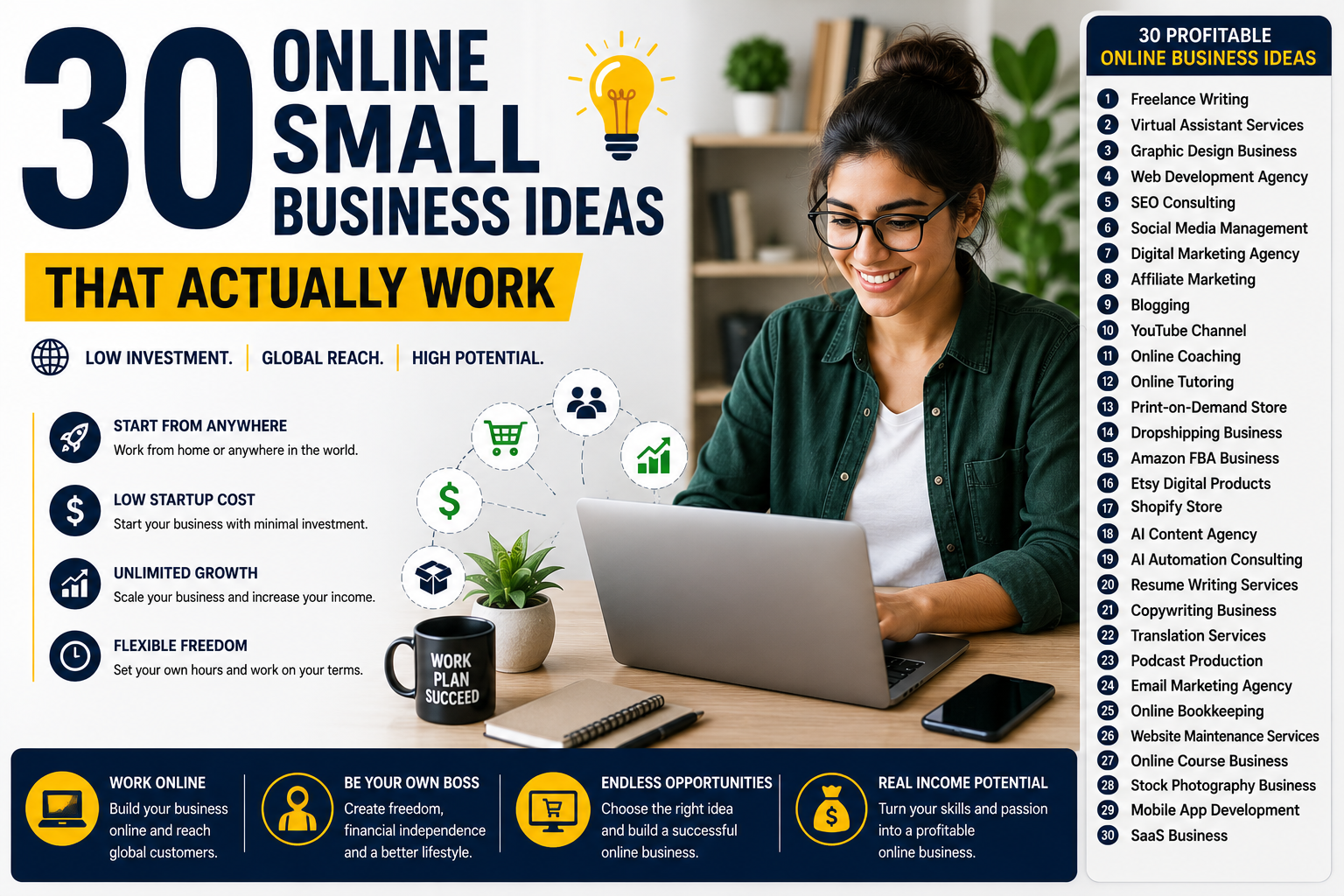
30 Online Small Business Ideas That Actually Work
1. Freelance Writing
Overview: Freelance writers create articles, blog posts, website copy, whitepapers, and more for businesses, publications, and entrepreneurs.
Why it works: Every business needs content. The demand is steady and diverse.
Startup cost: Under $50 (portfolio website)
Skills required: Strong writing, research, grammar, meeting deadlines
Income potential: $30,000–$120,000+ per year
Pros: Low barrier to entry; flexible; wide variety of work
Challenges: Building a client base takes time; income can be inconsistent early on
Quick tip: Start with a free portfolio on Contently or a simple WordPress site, then pitch three local businesses this week.
2. Virtual Assistant Services
Overview: Virtual assistants (VAs) handle administrative tasks like email management, scheduling, data entry, customer service, and research for busy entrepreneurs and executives.
Why it works: Small business owners often need help but can’t justify a full-time hire.
Startup cost: Under $100
Skills required: Organization, communication, time management, basic tech literacy
Income potential: $25,000–$75,000+ per year
Pros: High demand; easy to specialize (social media VA, executive VA)
Challenges: Can feel repetitive; requires managing multiple clients simultaneously
Quick tip: Join platforms like Belay or Time Etc. to find your first clients while building your reputation.
3. Graphic Design Business
Overview: Graphic designers create logos, social media graphics, marketing materials, and brand identities for clients.
Why it works: Visual branding is essential for every business, large or small.
Startup cost: $200–$800 (design software, portfolio site)
Skills required: Design fundamentals, typography, color theory, software proficiency
Income potential: $40,000–$150,000+ per year
Pros: Creative work; strong freelance marketplace; scalable into an agency
Challenges: Highly competitive; clients can have demanding revision requests
Quick tip: Build a niche portfolio—logos for restaurants or packaging for consumer brands—to stand out.
4. Web Development Agency
Overview: Web developers build websites and web applications for businesses, often specializing in platforms like WordPress, Shopify, or custom-coded solutions.
Why it works: Every new business needs a website. It’s a perpetual market.
Startup cost: $200–$1,000
Skills required: HTML, CSS, JavaScript, CMS platforms, problem-solving
Income potential: $60,000–$200,000+ per year
Pros: High-value service; excellent referral potential; recurring revenue from maintenance
Challenges: Steep learning curve; clients sometimes have unclear requirements
Quick tip: Offer a free or discounted website to a local nonprofit in exchange for a testimonial and portfolio piece.
5. SEO Consulting
Overview: SEO consultants help businesses improve their visibility in search engine results, driving more organic traffic to their websites.
Why it works: Businesses understand that showing up on Google is essential. Few know how to make it happen.
Startup cost: $100–$500 (tools and courses)
Skills required: Technical analysis, content strategy, link building, analytical thinking
Income potential: $50,000–$180,000+ per year
Pros: High-value skill; retainer-based income is common; growing demand
Challenges: Results take time; algorithm changes can impact your strategies
Quick tip: Start by auditing a small local business’s online presence for free. Use it as your proof-of-concept case study.
6. Social Media Management
Overview: Social media managers create content, schedule posts, engage with followers, and run paid campaigns for business clients.
Why it works: Businesses know they need a social presence but often don’t have the time or expertise to manage it.
Startup cost: Under $200
Skills required: Content creation, platform knowledge, analytics, copywriting
Income potential: $30,000–$90,000+ per year
Pros: High demand; can manage multiple clients; creative work
Challenges: Constantly evolving platforms; clients may want instant results
Quick tip: Specialize in one or two platforms (like Instagram and TikTok for a restaurant) rather than offering everything.
7. Digital Marketing Agency
Overview: A digital marketing agency offers a bundle of services—content creation, paid advertising, email marketing, social media, and strategy—typically under one roof.
Why it works: Businesses prefer working with one agency rather than juggling multiple freelancers.
Startup cost: $500–$2,000
Skills required: Marketing strategy, team management, client communication, multi-channel expertise
Income potential: $80,000–$500,000+ per year
Pros: High revenue ceiling; scalable with contractors; recurring monthly retainers
Challenges: Managing client expectations; requires strong project management
Quick tip: Start as a solo freelancer in one marketing discipline, then add services and contractors as revenue grows.
8. Affiliate Marketing
Overview: Affiliate marketers promote other companies’ products and earn a commission for each sale or lead generated through their unique link.
Why it works: No product creation, no inventory, no customer service required.
Startup cost: $100–$500 (website, content tools)
Skills required: Content creation, audience building, basic analytics
Income potential: $10,000–$500,000+ per year (highly variable)
Pros: Passive income potential; low startup cost; no product required
Challenges: Takes time to build traffic; income can be inconsistent
Quick tip: Focus on a specific niche (like budget travel gear or home office setups) and build a content site around it.
9. Blogging
Overview: Bloggers create written content around a specific topic and monetize through ads, affiliate links, sponsored posts, and digital products.
Why it works: Niche blogs with loyal audiences are extremely valuable to advertisers and brands.
Startup cost: $50–$200
Skills required: Writing, consistency, basic website management, patience
Income potential: $5,000–$250,000+ per year (takes time to build)
Pros: Multiple monetization options; builds personal authority; can become passive income
Challenges: Takes 12–24 months to gain meaningful traction
Quick tip: Choose a specific niche you know well and publish consistently for at least 12 months before judging results.
10. YouTube Channel
Overview: YouTubers create video content around a specific niche, monetizing through ad revenue, sponsorships, merchandise, and affiliate marketing.
Why it works: Video content continues to dominate online consumption. YouTube is the world’s second-largest search engine.
Startup cost: $200–$1,500 (camera, microphone, editing software)
Skills required: On-camera comfort, video editing, storytelling, consistency
Income potential: $10,000–$1,000,000+ per year (highly variable)
Pros: Multiple revenue streams; massive discovery potential; builds strong audience connections
Challenges: Competitive; requires consistent production; monetization takes time
Quick tip: Start with your phone’s camera—equipment matters less than content quality and consistency.
11. Online Coaching
Overview: Online coaches help clients achieve specific goals—fitness, career, relationships, business, mindset—through one-on-one or group sessions via video call.
Why it works: People pay well for personalized guidance and accountability.
Startup cost: Under $300
Skills required: Expertise in your coaching area, communication, empathy, session planning
Income potential: $40,000–$300,000+ per year
Pros: High-margin; deeply rewarding; scalable through group programs
Challenges: Requires building credibility and trust before clients pay
Quick tip: Offer three free “discovery sessions” to potential clients, gather testimonials, and use them to market your paid packages.
12. Online Tutoring
Overview: Online tutors teach academic subjects, test preparation, or professional skills through platforms or their own websites.
Why it works: Parents and students are always seeking qualified academic support, especially for standardized tests.
Startup cost: Under $100
Skills required: Subject matter expertise, patience, clear explanation skills
Income potential: $25,000–$80,000+ per year
Pros: Steady demand; flexible hours; minimal overhead
Challenges: Competitive pricing on marketplace platforms; limited scalability without hiring
Quick tip: List on Wyzant or Tutor.com to start, then build a direct client base to avoid platform commission fees.
13. Print-on-Demand Store
Overview: You design graphics for t-shirts, mugs, tote bags, and other products. A third-party company prints and ships each item when a customer orders.
Why it works: No inventory risk. You only pay for an item when it’s sold.
Startup cost: $50–$300
Skills required: Basic design, niche research, e-commerce setup
Income potential: $10,000–$100,000+ per year
Pros: Zero inventory; passive once set up; wide product range
Challenges: Lower profit margins; competitive market
Quick tip: Focus on a passionate niche (nurses who love hiking, dog owners in Texas) rather than generic designs.
14. Dropshipping Business
Overview: You sell products online without holding inventory. When a customer orders, a third-party supplier ships the product directly to them.
Why it works: Low startup risk; you test product ideas without investing in stock.
Startup cost: $200–$1,000
Skills required: Product research, digital advertising, customer service, store management
Income potential: $20,000–$500,000+ per year
Pros: No inventory management; wide product selection; scalable
Challenges: Thin profit margins; supplier reliability issues; heavy reliance on paid advertising
Quick tip: Use DSers or Zendrop to find reliable suppliers and test products in small ad campaigns before scaling.
15. Amazon FBA Business
Overview: You source or create products, send them to Amazon’s warehouses, and Amazon handles storage, packing, and shipping. FBA stands for Fulfillment by Amazon.
Why it works: You leverage Amazon’s massive customer base and logistics infrastructure.
Startup cost: $1,000–$5,000+
Skills required: Product sourcing, market research, inventory management, listing optimization
Income potential: $30,000–$500,000+ per year
Pros: Access to Amazon’s audience; hands-off fulfillment; proven model
Challenges: Higher startup cost; Amazon’s policies can be strict; requires capital for inventory
Quick tip: Use tools like Helium 10 or Jungle Scout to research product demand before investing in inventory.
16. Etsy Digital Products
Overview: Sell downloadable files—planners, templates, printables, fonts, invitations—on Etsy’s marketplace. Customers download their purchase immediately.
Why it works: Create once, sell indefinitely with zero additional effort or cost.
Startup cost: $50–$200
Skills required: Design, niche research, Etsy shop management
Income potential: $10,000–$150,000+ per year
Pros: Truly passive once listings are live; low overhead; built-in marketplace traffic
Challenges: Competitive; requires strong product photography and listings
Quick tip: Research top-selling digital products in your category using Etsy’s search suggestions and EverBee analytics tool.
17. Shopify Store
Overview: Build and run your own branded e-commerce store using Shopify to sell physical products, digital products, or even services.
Why it works: You own your customer relationships, unlike selling on third-party marketplaces.
Startup cost: $300–$2,000
Skills required: E-commerce management, product sourcing, marketing, customer service
Income potential: $20,000–$1,000,000+ per year
Pros: Full control of your brand; scalable; multiple app integrations available
Challenges: Driving traffic is your responsibility; requires strong marketing
Quick tip: Shopify offers a free trial. Build your store first, then focus intensely on driving traffic through content or social media.
18. AI Content Agency
Overview: Help businesses plan, produce, and publish consistent content by combining human editorial judgment with modern productivity tools and workflows.
Why it works: Content demand keeps growing. Many businesses struggle with consistency.
Startup cost: $200–$600
Skills required: Content strategy, editing, project management, client communication
Income potential: $50,000–$200,000+ per year
Pros: High demand; scalable with a team; recurring revenue model
Challenges: Requires strong quality control processes; competitive space
Quick tip: Position your agency around a specific industry (healthcare, real estate, SaaS) to differentiate from generalist competitors.
19. AI Automation Consulting
Overview: Help small businesses implement workflow automation tools to save time on repetitive tasks like invoicing, email follow-ups, and reporting.
Why it works: Most small business owners know they need to automate—they just don’t know where to start.
Startup cost: $200–$1,000
Skills required: Systems thinking, workflow tools (Zapier, Make), client communication
Income potential: $60,000–$200,000+ per year
Pros: High-value consulting; growing demand; recurring retainer potential
Challenges: Requires staying current with rapidly evolving tools
Quick tip: Learn Zapier and Make thoroughly, then document five common workflows you can build for small business clients.
20. Resume Writing Services
Overview: Professional resume writers help job seekers create compelling resumes, LinkedIn profiles, and cover letters.
Why it works: Job seekers understand that a strong resume directly impacts their earning potential and are willing to invest accordingly.
Startup cost: Under $100
Skills required: Strong writing, understanding of hiring practices, career knowledge
Income potential: $30,000–$100,000+ per year
Pros: High perceived value; straightforward service; repeat customers during career transitions
Challenges: Competitive; requires staying current with hiring trends
Quick tip: Specialize by industry or career level (executive resumes, tech professionals) to command premium pricing.
21. Copywriting Business
Overview: Copywriters write persuasive marketing content—sales pages, email sequences, ads, and product descriptions—that drives customer action.
Why it works: Good copy directly impacts a business’s revenue. It’s one of the most valued marketing skills.
Startup cost: Under $200
Skills required: Persuasive writing, psychology, marketing fundamentals, research
Income potential: $50,000–$250,000+ per year
Pros: High earning potential; flexible; strong demand
Challenges: Building a portfolio from scratch requires patience
Quick tip: Study the foundational copywriting books (like those by David Ogilvy or Gary Halbert), then write spec samples for fictional or real brands.
22. Translation Services
Overview: Translators convert written content between languages for businesses, legal firms, publishers, and global brands.
Why it works: As businesses go global, demand for accurate, professional translation grows steadily.
Startup cost: Under $100
Skills required: Fluency in at least two languages, attention to detail, cultural knowledge
Income potential: $30,000–$90,000+ per year
Pros: Steady demand; niche specializations (legal, medical) command premium rates
Challenges: Technology continues to improve machine translation, increasing competition
Quick tip: Specialize in a high-stakes field (legal contracts, medical documents) where accuracy is non-negotiable and rates reflect that.
23. Podcast Production
Overview: Podcast producers help hosts with recording, editing, show notes, distribution, and episode management.
Why it works: Millions of people have launched podcasts, but many struggle with the production side.
Startup cost: $200–$800 (audio software and equipment)
Skills required: Audio editing, project management, attention to detail
Income potential: $25,000–$80,000+ per year
Pros: Growing market; recurring client work; creative field
Challenges: Requires learning quality audio editing; managing multiple clients’ schedules
Quick tip: Offer to produce three episodes for a new podcast host for a reduced rate, then use the result as your portfolio.
24. Email Marketing Agency
Overview: Help businesses build email lists, create automated campaigns, write newsletters, and improve email performance metrics.
Why it works: Email marketing consistently delivers higher ROI than most other marketing channels, according to multiple industry studies.
Startup cost: $200–$600
Skills required: Email platform knowledge (Mailchimp, Klaviyo, ConvertKit), copywriting, strategy
Income potential: $50,000–$180,000+ per year
Pros: High ROI for clients; measurable results; recurring retainers common
Challenges: Deliverability issues; requires constant testing and optimization
Quick tip: Build and grow your own email list first. Potential clients will trust someone who has demonstrated results in their own business.
25. Online Bookkeeping
Overview: Online bookkeepers manage financial records, reconcile accounts, and prepare reports for small business clients remotely.
Why it works: Every business needs accurate financial records. Few small business owners have the time or expertise to handle it themselves.
Startup cost: $200–$800 (accounting software, certification courses)
Skills required: Numerical accuracy, attention to detail, accounting software proficiency
Income potential: $40,000–$100,000+ per year
Pros: Stable demand; recurring monthly income; trusted professional relationship
Challenges: Requires continuing education; high responsibility
Quick tip: Earn a bookkeeping certification through AIPB or QuickBooks to build credibility, then target small local service businesses.
26. Website Maintenance Services
Overview: Website maintenance providers keep clients’ websites updated, secure, backed up, and running smoothly on a monthly retainer basis.
Why it works: Business owners build websites and then forget about them—until something breaks.
Startup cost: $100–$400
Skills required: CMS knowledge (WordPress), basic troubleshooting, plugin management
Income potential: $30,000–$80,000+ per year
Pros: Predictable monthly income; low time commitment per client; scalable
Challenges: Technical issues can arise unexpectedly; clients may undervalue the service
Quick tip: Approach local businesses with outdated or slow websites. Offer a free audit and pitch a monthly care plan.
27. Online Course Business
Overview: Create and sell structured courses teaching a skill, subject, or process through platforms like Teachable, Thinkific, or your own website.
Why it works: People are eager to learn skills that improve their lives or careers and prefer self-paced online formats.
Startup cost: $300–$1,500
Skills required: Subject matter expertise, curriculum design, video production, marketing
Income potential: $20,000–$1,000,000+ per year
Pros: True passive income once built; scalable; establishes authority
Challenges: Significant upfront work; requires an existing audience or marketing budget
Quick tip: Validate your course idea by preselling it before you build it. If people pay in advance, you’ve confirmed real demand.
28. Stock Photography Business
Overview: Photographers upload images to stock sites (Shutterstock, Adobe Stock, Getty Images) and earn royalties each time someone licenses a photo.
Why it works: Businesses, designers, and publishers constantly need high-quality images for content.
Startup cost: $500–$3,000 (camera equipment)
Skills required: Photography, photo editing, understanding of commercial demand
Income potential: $5,000–$80,000+ per year
Pros: Passive income; creative work; images sell repeatedly
Challenges: Requires large volume of uploads to earn significantly; highly competitive
Quick tip: Research what types of images consistently sell (diverse business scenarios, lifestyle content, food photography) and focus there.
29. Mobile App Development
Overview: Mobile app developers design and build applications for iOS and Android platforms for clients or their own app products.
Why it works: Demand for custom apps across industries continues to grow as mobile usage dominates internet traffic.
Startup cost: $500–$2,000 (development tools and courses)
Skills required: Programming (Swift, Kotlin, Flutter), UI/UX principles, problem-solving
Income potential: $70,000–$300,000+ per year
Pros: High-value skill; diverse client base; option to build your own revenue-generating apps
Challenges: Steep learning curve; long project timelines; competitive field
Quick tip: Build a simple app that solves one specific problem and use it as your portfolio centerpiece.
30. SaaS (Software as a Service) Business
Overview: SaaS founders build web-based software products that customers access via subscription—tools for project management, invoicing, scheduling, and more.
Why it works: Subscription software generates predictable, recurring revenue and can scale globally without proportional cost increases.
Startup cost: $2,000–$20,000+
Skills required: Software development (or ability to hire), product design, business strategy, marketing
Income potential: $50,000–$10,000,000+ per year
Pros: Highest scalability of any business model; strong investor appeal; recurring revenue
Challenges: High technical complexity; requires significant development investment; competitive market
Quick tip: Start with a narrow problem that a specific professional group (dentists, real estate agents, yoga studios) faces daily. Narrow focus beats broad ambition every time.
Best Online Business Ideas by Budget
| Budget | Recommended Online Businesses |
|---|---|
| Under $100 | Freelance writing, virtual assistant services, online tutoring, resume writing, translation services |
| Under $500 | Graphic design, social media management, affiliate marketing, blogging, print-on-demand, podcast production |
| Under $1,000 | Web development, online coaching, email marketing agency, bookkeeping, Etsy digital products, Shopify store |
| Over $1,000 | Amazon FBA, mobile app development, online course creation, SaaS business, digital marketing agency |
Essential Tools for Running an Online Business
| Category | Recommended Tools |
|---|---|
| Website Building | WordPress, Squarespace, Shopify |
| Email Marketing | Mailchimp, ConvertKit, Klaviyo |
| Accounting | QuickBooks, FreshBooks, Wave |
| Graphic Design | Canva, Adobe Creative Cloud, Figma |
| Project Management | Trello, Asana, Notion |
| Video Meetings | Zoom, Google Meet, Calendly |
| Social Media Scheduling | Buffer, Later, Hootsuite |
| Productivity | Notion, Zapier, Make (Integromat) |
| Payment Processing | Stripe, PayPal, Square |
Common Mistakes to Avoid
1. Choosing the wrong niche. Picking something too broad (like “health”) or something with no real market demand is a fast road to frustration. Validate demand before you commit.
2. Skipping market research. Assuming people want what you’re offering without actually checking is a costly mistake. Talk to potential customers first.
3. Poor branding. A forgettable business name, a low-quality logo, or an inconsistent visual identity signals to potential clients that you’re not serious.
4. Weak marketing. Building something excellent and then waiting for customers to find you won’t work. You need an active marketing strategy from day one.
5. Underpricing your services. New business owners often price themselves too low out of fear. Low prices attract difficult clients and burn you out fast.
6. Depending on one traffic source. If your only customers come from Instagram and the algorithm changes, you’re in trouble. Diversify where your leads come from.
7. Ignoring customer support. Happy customers refer new clients. Ignored complaints become public negative reviews. Treat every customer interaction seriously.
Expert Tips for Growing an Online Business
Finding your first customers: Don’t wait for your website to be perfect. Tell people in your existing network what you’re doing. Your first customer is almost always someone you already know or someone they refer you to.
Building a personal brand: People buy from people they trust. Share your expertise on LinkedIn, in a newsletter, or on social media. Over time, this builds authority that brings clients to you without cold outreach.
Creating recurring income: One-time projects are exhausting to sustain. Look for ways to offer retainers, subscriptions, or ongoing service packages that give both you and your client long-term stability.
Using content marketing: Publishing helpful articles, videos, or posts on topics your ideal customers search for is one of the most cost-effective ways to generate leads over time.
Leveraging social media strategically: You don’t need to be on every platform. Pick one or two where your target audience spends time and show up consistently there.
Automating repetitive tasks: Identify the administrative tasks that eat your time—scheduling, invoicing, follow-up emails—and automate them using tools like Zapier. This frees you to focus on work that actually grows the business.
Scaling with a team: When you hit a revenue ceiling as a solo operator, it’s time to bring in help. Start with one contractor for your most time-consuming task and reinvest the time saved into higher-value activities.
Frequently Asked Questions
1. What online business can I start with no money?
Freelance writing, virtual assisting, and online tutoring require almost no upfront investment. You can start with a free portfolio page and your existing skills.
2. How long does it take to make money from an online business?
Service businesses (freelancing, coaching, consulting) can generate income within 30–90 days. Content-based businesses like blogging or YouTube typically take 12–24 months to reach meaningful income.
3. Do I need a business license to run an online business?
Requirements vary by location and business type. In the U.S., most states require some form of business registration. Consult the SBA website or a local business advisor for guidance specific to your situation.
4. Which online business is most profitable?
SaaS, digital marketing agencies, and online courses have the highest profit potential. However, profitability depends far more on execution and market positioning than on the idea itself.
5. Can I run an online business while working full-time?
Yes. Many successful business owners started part-time. Service businesses and content-based models are particularly manageable alongside full-time employment if you’re disciplined with your time.
6. How do I get clients for my online business?
Start with your existing network. Then use LinkedIn outreach, content marketing, online freelance platforms, and referral programs. Consistency and follow-up are key.
7. Is dropshipping still a viable business model?
Yes, but margins are tighter than they were several years ago. Success in dropshipping today requires careful product selection, strong branding, and smart advertising strategy.
8. What is the easiest online business to start for beginners?
Virtual assistant services, freelance writing, and print-on-demand stores have the lowest learning curves and startup costs for complete beginners.
9. How much money can I realistically make from an online business?
Ranges vary enormously. According to BLS data, self-employed professionals in digital fields earn median incomes comparable to or exceeding their employed counterparts, particularly in tech, marketing, and consulting. Most new online businesses generate modest income in the first year and grow from there.
10. Do I need a website to start an online business?
Not necessarily at first. You can start on LinkedIn, Upwork, Etsy, or social media. However, having your own website builds credibility and removes your dependence on third-party platform rules.
Conclusion
Thirty ideas is a lot to process. But here’s the simple truth: you only need one that fits your skills, your interests, and your budget. You don’t need to be an expert before you start. You just need to be willing to learn, stay consistent, and take the first step before you feel fully ready—because that moment rarely comes on its own.
If you’re a strong writer, start pitching clients for freelance work this week. If you have a teachable skill, outline your first online course. If you love product research, build a small print-on-demand store this weekend. The tools are accessible. The market is there. The main variable is you.
Don’t spend another six months in the planning phase. Pick one idea from this list, make a commitment to it for six months, and learn what you need to learn as you go. That’s how most successful online business owners actually did it. Not with a perfect plan on day one, but with consistent action over time.
Your next step? Choose one idea. Then do one concrete thing for it today.
References
- U.S. Small Business Administration (SBA): sba.gov
- SCORE Mentors: score.org
- U.S. Bureau of Labor Statistics — Occupational Outlook Handbook: bls.gov/ooh
- IRS Self-Employed Tax Center: irs.gov
- World Bank Small Business Resources: worldbank.org
- Harvard Business Review — Small Business: hbr.org
- McKinsey & Company — Digital Business Insights: mckinsey.com
- Shopify Annual Commerce Report: shopify.com
- Google for Small Business: grow.google/smallbusiness
Business Disclaimer
This article is provided for informational and educational purposes only. The online business ideas, startup costs, income potential, and strategies discussed are based on general industry information and should not be considered financial, legal, tax, or professional business advice. Actual results may vary depending on your skills, experience, market demand, location, competition, and business execution. Unlocked The Magazine does not guarantee earnings, profits, or business success. Always conduct your own research and consult qualified financial, legal, or business professionals before starting, investing in, or operating any online business.