

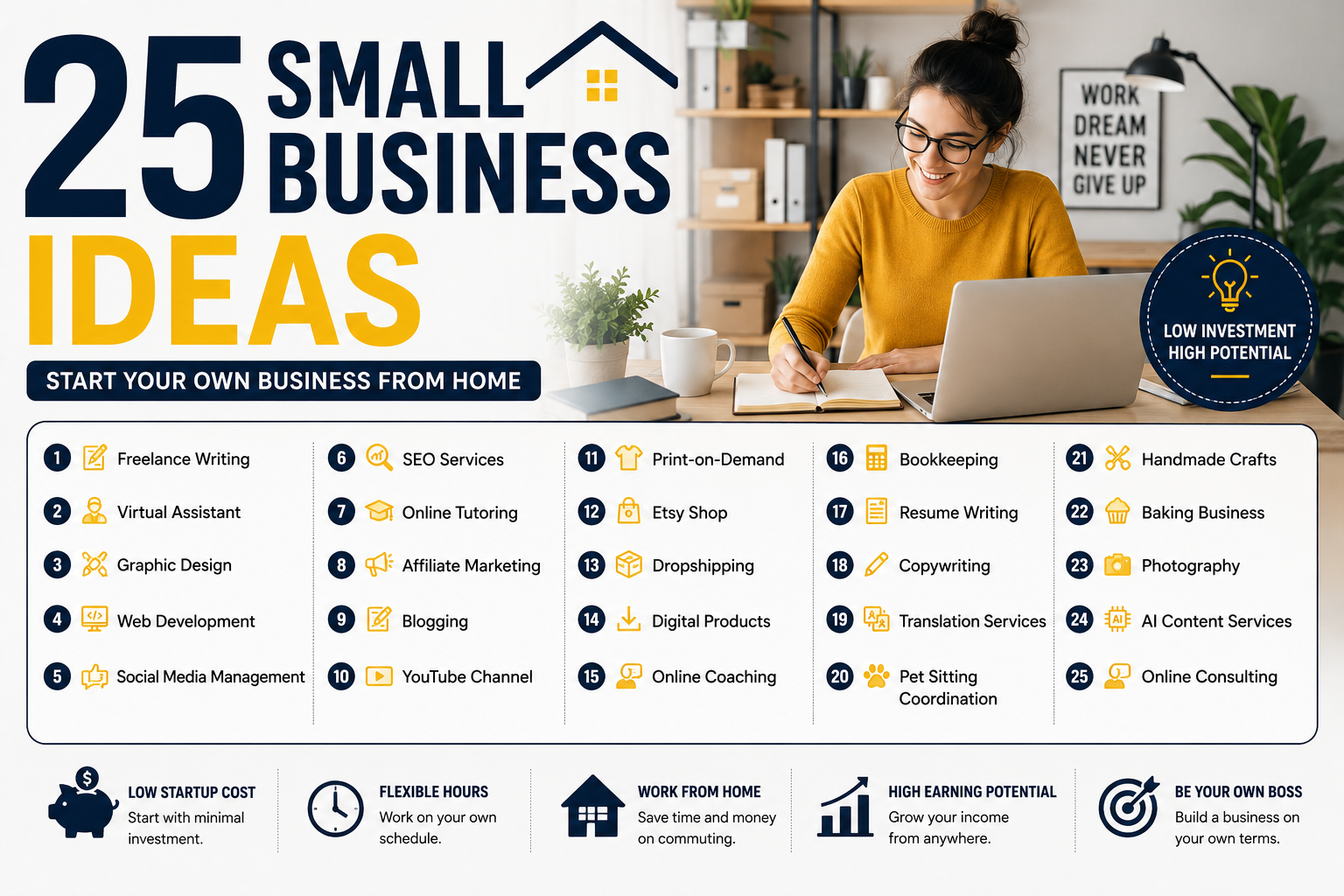
Quick Answer
You can start a profitable home-based business with ideas like freelance writing, virtual assistance, graphic design, online tutoring, social media management, or e-commerce (dropshipping, Etsy shop, print-on-demand). Many require less than $500 to launch. The best choice depends on your skills, budget, and time availability. Focus on service-based businesses for quick income or product-based models for scalability.
Introduction
Working from home isn’t just a trend anymore—it’s become a legitimate path to financial independence and career satisfaction. The global shift toward remote work, accelerated by recent years, has opened doors for millions of people to start businesses right from their living rooms, spare bedrooms, or kitchen tables.
According to the U.S. Small Business Administration, over half of all small businesses in America are home-based, and that number continues to grow. Whether you’re a parent looking for flexible income, a recent graduate exploring entrepreneurship, or someone tired of the 9-to-5 grind, starting a home business offers an accessible entry point.
The beauty of home-based businesses today is the variety. You don’t need a storefront, expensive equipment, or even inventory in many cases. With just a laptop, internet connection, and marketable skills, you can build a sustainable income stream.
This guide explores 25 realistic, proven business ideas you can launch from home in 2025. Some require specialized skills, while others need just determination and willingness to learn. We’ll break down startup costs, income potential, and practical steps to get started—so you can choose the right fit for your situation.
What Is a Home-Based Small Business?
A home-based small business is any legitimate commercial activity operated primarily from your residence. This could mean offering services, selling products, creating digital content, or consulting—all managed from your home office.
How it differs from traditional businesses:
Traditional businesses typically require:
- Commercial lease or storefront
- Significant startup capital
- Employees and overhead costs
- Fixed operating hours
- Physical inventory or equipment
Home-based businesses, by contrast:
- Operate from residential space
- Start with minimal investment
- Can run solo or with virtual teams
- Offer flexible scheduling
- Often leverage digital tools and platforms
Legal considerations:
Home businesses are legitimate enterprises, but you’ll need to:
- Check local zoning laws (some neighborhoods restrict certain business activities)
- Obtain necessary licenses or permits
- Register your business name
- Track income for tax purposes
- Potentially get business insurance
Most service-based and online businesses face few restrictions, while businesses involving clients visiting your home, manufacturing, or food preparation may have additional regulations.
Advantages:
- Lower barrier to entry
- Test business ideas with minimal risk
- Scale gradually as you grow
- Maintain work-life integration
- Keep day job while building business
Limitations:
- Limited space for inventory or operations
- Potential distractions at home
- Difficulty separating work and personal life
- Zoning restrictions in some areas
- May outgrow home space as business expands
Despite these limitations, thousands of successful businesses started at home—including Apple, Amazon, and Disney. Your home-based startup could be the next success story.
Benefits of Starting a Business from Home
Low Startup Costs
Traditional brick-and-mortar businesses can require $50,000 to $100,000+ in startup capital. Home businesses often launch for under $1,000—sometimes just a few hundred dollars.
What you save:
- No commercial rent ($1,000-5,000/month)
- No buildout or renovation costs ($10,000-50,000+)
- Minimal equipment needs
- Lower insurance premiums
- No commuting costs
You can invest those savings directly into growing your business, marketing, or building financial security.
Flexible Working Hours
Control your schedule completely. Want to work early mornings? Late nights? Around your kids’ school hours? You decide.
This flexibility means:
- Attend family events without asking permission
- Schedule doctor appointments freely
- Work during your most productive hours
- Take breaks when needed
- Balance multiple responsibilities
For parents, caregivers, or anyone with non-traditional schedules, this flexibility is priceless.
Better Work-Life Balance
Eliminate the commute (Americans average 27 minutes each way, according to the U.S. Census Bureau) and reclaim 4.5+ hours weekly. That’s time with family, for exercise, hobbies, or simply resting.
Working from home allows you to:
- Have lunch with family
- Exercise during the day
- Handle household tasks during breaks
- Reduce stress from commuting
- Create environment suited to your needs
Tax Advantages
The IRS allows home business owners to deduct legitimate business expenses, including a portion of home-related costs.
Potential deductions (consult a tax professional):
- Home office space (percentage of rent/mortgage)
- Utilities (proportional to business use)
- Internet and phone
- Office supplies and equipment
- Business software and subscriptions
- Professional development and education
- Marketing and advertising costs
These deductions can save thousands annually in taxes.
Scalability
Start small, test your concept, and scale as demand grows—all without signing long-term leases or making major capital investments.
Scalability advantages:
- Hire virtual assistants or contractors when ready
- Expand services without physical constraints
- Test different business models
- Grow at your own pace
- Pivot quickly based on market response
Reduced Overhead Expenses
Without rent, utilities for commercial space, and employee costs, your overhead stays minimal. This means:
- Higher profit margins
- Less revenue needed to break even
- More money for marketing and growth
- Financial flexibility during slow periods
- Ability to offer competitive pricing
Lower overhead also means lower risk—if business slows down temporarily, you’re not hemorrhaging money on fixed costs.
How to Choose the Right Home Business
Not every business idea fits every person. The key to sustainable success is choosing something aligned with your skills, interests, resources, and market demand.
Assess Your Skills
Start with what you already know:
Make a list of:
- Professional skills (marketing, accounting, design, writing, coding)
- Technical abilities (software proficiency, tools you can use)
- Soft skills (communication, organization, teaching, problem-solving)
- Hobbies and interests (photography, baking, crafts, fitness)
The faster you can deliver value, the quicker you’ll earn income. Building entirely new skills first delays your launch.
Skills inventory questions:
- What do people frequently ask me for help with?
- What skills does my current/past job use?
- What do I do better than most people I know?
- What have I been complimented on professionally?
Identify Your Interests
Passion doesn’t guarantee success, but it sustains you through challenges. You’ll invest hundreds of hours building this business—choose something you won’t dread doing.
Questions to ask:
- What topics do I read about for fun?
- What could I talk about for hours?
- What problems do I enjoy solving?
- What would I do even if pay was modest?
The intersection of skills and interests is your sweet spot.
Evaluate Your Budget
Be honest about available capital. Some businesses start with under $100, while others need $1,000-2,000 for equipment, software, or inventory.
Budget considerations:
- Available cash for startup costs
- Ability to invest in tools or education
- Runway (how long can you operate without profit?)
- Willingness to bootstrap vs. seeking funding
Remember: Starting lean is often better. You can always invest more as you prove the concept.
Research Market Demand
Your brilliant idea needs paying customers. Before committing, validate demand.
Validation steps:
- Google your service/product (are others successfully selling it?)
- Check freelance platforms (Upwork, Fiverr) for similar services
- Browse Facebook groups in your niche (what are people asking for?)
- Use Google Trends to see interest over time
- Talk to potential customers directly
Existing competition usually signals healthy demand—it means people are willing to pay for this solution.
Analyze Competition
Competition isn’t bad; it validates your market. Study competitors to find your advantage.
Research questions:
- Who are the main players?
- What do they charge?
- What do their customers complain about? (opportunity!)
- What do they do well? (learn from it)
- How can you differentiate?
You don’t need to be completely unique—just better at serving a specific audience or solving a particular problem.
Consider Income Potential
Different businesses have different earning ceilings and timelines to profitability.
Income factors:
- How much can you realistically charge?
- How many clients/customers can you serve?
- Is income recurring or one-time?
- How long until first dollar earned?
- What’s the income ceiling?
Service businesses often generate income faster but have time-based limits. Product businesses take longer to build but can scale beyond your personal hours.
Assess Time Commitment
Be realistic about available time.
Questions:
- How many hours weekly can I dedicate?
- Is this full-time or side hustle?
- Can I handle client deadlines?
- What’s the minimum time to run this business?
Some businesses (virtual assistant, freelancing) require consistent availability. Others (blogging, e-commerce) offer more flexible timing once established.
Match all factors:
The right business sits at the intersection of:
- Skills you have
- Work you enjoy
- Market demand exists
- Budget you can afford
- Income meets your needs
- Time you can commit
Don’t expect perfect alignment on all factors. Prioritize what matters most to your situation.
25 Small Business Ideas You Can Start from Home
1. Freelance Writing
Overview:
Create written content for businesses, websites, magazines, or individuals. Types include blog posts, articles, website copy, email newsletters, white papers, and case studies.
Why it’s profitable:
Content marketing is essential for modern businesses. Companies need constant content but often lack in-house writers. The Content Marketing Institute reports that 70% of marketers actively invest in content marketing, creating steady demand.
Estimated startup cost: $0-300
- Computer (likely already own)
- Grammarly or editing software ($0-12/month)
- Portfolio website (optional: $0-20/month)
Required skills:
- Strong writing ability
- Grammar and punctuation mastery
- Research skills
- Understanding of different writing styles
- Basic SEO knowledge (helpful but learnable)
Earning potential:
- Beginners: $0.03-0.10 per word ($30-100 per 1,000-word article)
- Intermediate: $0.10-0.50 per word ($100-500 per article)
- Experienced: $0.50-2.00+ per word or $150-1,000+ per article
- Monthly income: $500-10,000+ depending on volume and rates
Pros:
- Very low startup costs
- Work from anywhere
- Flexible scheduling
- High demand across industries
- Scalable (hire other writers as you grow)
Challenges:
- Income inconsistency when starting
- Finding quality clients takes time
- Competitive market for beginners
- Need to constantly market yourself
- Can be deadline-intensive
Tips for getting started:
- Choose a niche (finance, health, technology, marketing) to stand out
- Build 3-5 sample pieces for your portfolio
- Sign up on Upwork, Fiverr, or Contently to find first clients
- Network in LinkedIn groups related to your niche
- Pitch guest posts to publications to build credibility
- Set clear rates and don’t undervalue your work
- Collect testimonials from every satisfied client
2. Virtual Assistant
Overview:
Provide administrative, technical, or creative support to clients remotely. Tasks include email management, scheduling, customer service, data entry, social media posting, and project coordination.
Why it’s profitable:
Entrepreneurs and small businesses need help but can’t justify full-time employees. Virtual assistants provide flexible, affordable support. The global virtual assistant market is expected to continue growing as remote work normalizes.
Estimated startup cost: $0-500
- Computer and internet (already have)
- Project management tools (many free options)
- Communication tools like Zoom ($0-15/month)
- Time tracking software ($0-10/month)
Required skills:
- Strong organizational abilities
- Excellent communication
- Time management
- Proficiency in Microsoft Office or Google Workspace
- Adaptability to learn new tools
- Attention to detail
Earning potential:
- Beginners: $15-25/hour
- Experienced: $25-50/hour
- Specialized VAs: $50-100+/hour
- Monthly income: $1,000-8,000+ depending on hours and rates
Pros:
- Low barrier to entry
- Diverse tasks keep work interesting
- Build relationships with clients
- Scalable (hire team and become agency)
- Steady, recurring income from retainer clients
Challenges:
- Multiple clients can mean juggling priorities
- May require availability during specific hours
- Building initial client base takes effort
- Income tied to hours worked
- Scope creep if boundaries aren’t set
Tips for getting started:
- Identify your specialized services (general admin, social media, bookkeeping, etc.)
- Create professional profiles on Belay, Time Etc, or Upwork
- Set clear packages (10 hours/month, 20 hours/month) with defined tasks
- Use tools like Trello, Asana, or ClickUp to stay organized
- Establish communication protocols with clients upfront
- Track time meticulously to justify your value
- Ask for referrals from satisfied clients
3. Graphic Design
Overview:
Create visual content for businesses including logos, branding materials, social media graphics, advertisements, website designs, packaging, and marketing collateral.
Why it’s profitable:
Every business needs visual branding, and many small businesses can’t afford full-time designers. Good design directly impacts sales and brand perception, making it valuable.
Estimated startup cost: $0-1,000
- Computer (ideally with good specs)
- Design software: Adobe Creative Cloud ($54.99/month) or free alternatives like Canva Pro ($12.99/month), GIMP, or Figma
- Portfolio website ($0-30/month)
- Stock photo subscriptions (optional: $0-30/month)
Required skills:
- Design principles (color theory, typography, composition)
- Software proficiency (Photoshop, Illustrator, InDesign, or alternatives)
- Understanding of branding
- Client communication and feedback incorporation
- File preparation for print and digital
Earning potential:
- Logo design: $100-5,000+
- Social media graphics: $50-300 per set
- Brand identity package: $500-10,000+
- Hourly rate: $25-150+
- Monthly income: $1,000-15,000+ depending on projects and experience
Pros:
- Creative and fulfilling work
- High demand across all industries
- Portfolio-based (formal degree not always required)
- Work with diverse clients and projects
- Can specialize in niches (restaurant branding, book covers, etc.)
Challenges:
- Competitive field
- Requires continuous learning as design trends evolve
- Subjective feedback can be frustrating
- Software costs can be significant
- Revisions can extend project timelines
Tips for getting started:
- Build a portfolio even if you haven’t had paid clients (redesign existing brands, create mock projects)
- Specialize in a niche to stand out (e-commerce, coaches, restaurants)
- Use platforms like 99designs, Dribbble, or Behance to showcase work
- Offer package deals (logo + business card + social media templates)
- Study design trends but develop your unique style
- Set clear revision limits in contracts
- Network in entrepreneur and small business communities
4. Web Development
Overview:
Build, maintain, and improve websites for individuals and businesses. Services include custom website development, WordPress setup and customization, e-commerce sites, site maintenance, and troubleshooting.
Why it’s profitable:
Every business needs an online presence, yet most business owners lack coding skills. Web developers are essential, and specialized skills (e-commerce, custom applications) command premium rates.
Estimated startup cost: $0-500
- Computer (decent specs helpful)
- Code editor (free: VS Code, Sublime Text)
- Web hosting for portfolio ($3-10/month)
- Domain name ($10-15/year)
- Learning resources if needed ($0-200)
Required skills:
- HTML, CSS, JavaScript
- Frameworks (React, Vue, or Angular for advanced work)
- WordPress, Shopify, or other CMS platforms
- Responsive design principles
- Basic SEO understanding
- Problem-solving and debugging
Earning potential:
- Simple WordPress site: $500-3,000
- Custom website: $2,000-20,000+
- E-commerce site: $3,000-25,000+
- Hourly rate: $50-200+
- Monthly income (retainers + projects): $3,000-20,000+
Pros:
- High income potential
- Strong job security (constant demand)
- Can work remotely from anywhere
- Continuous learning keeps work interesting
- Build long-term client relationships through maintenance
Challenges:
- Requires technical skills and ongoing education
- Client expectations can be unrealistic
- Browser compatibility issues can be time-consuming
- Pressure to stay current with technology changes
- Project scope can expand unexpectedly
Tips for getting started:
- If learning from scratch, take free courses (freeCodeCamp, The Odin Project, Codecademy)
- Build 3-5 portfolio sites (friends, nonprofits, or fictional businesses)
- Start with WordPress customization (lower barrier) before custom development
- Create packages (basic site, professional site, e-commerce site)
- Join freelance platforms (Toptal, Gun.io, Upwork)
- Offer maintenance packages for recurring revenue
- Stay updated through developer communities (Dev.to, Stack Overflow)
5. Social Media Management
Overview:
Manage social media accounts for businesses including content creation, scheduling, community engagement, analytics reporting, and strategy development across platforms like Instagram, Facebook, LinkedIn, TikTok, and Twitter.
Why it’s profitable:
Social media is critical for business growth, but most business owners lack time or expertise to manage it effectively. Businesses will pay for professional management that drives engagement and sales.
Estimated startup cost: $0-300
- Scheduling tools: Buffer, Later, or Hootsuite ($0-50/month)
- Canva Pro for graphics ($12.99/month)
- Analytics tools (many free options)
- Project management software ($0-15/month)
Required skills:
- Understanding of each platform’s algorithm and best practices
- Content creation (writing, basic graphic design)
- Community management and customer service
- Analytics interpretation
- Strategy development
- Trend awareness
Earning potential:
- Per platform: $300-2,000/month per client
- Full management (multiple platforms): $1,000-5,000+/month per client
- Additional services (content creation, ads): $500-3,000+
- Monthly income: $2,000-15,000+ with 5-10 clients
Pros:
- High demand from small to medium businesses
- Creative work with variety
- Relatively low startup costs
- Work from anywhere
- Scalable by hiring content creators or managers
Challenges:
- Requires consistent, often daily, activity
- Algorithm changes can impact strategy
- Results aren’t always immediate (client expectations)
- Can be time-consuming across multiple clients
- Need to stay current with platform changes and trends
Tips for getting started:
- Grow your own social media accounts first to demonstrate expertise
- Specialize in 2-3 platforms initially
- Offer free audits to attract first clients
- Create content calendars and batching systems
- Use scheduling tools to manage time efficiently
- Track metrics and present regular reports showing ROI
- Stay updated through social media marketing blogs and courses
6. SEO Services
Overview:
Help businesses improve their search engine rankings through keyword research, on-page optimization, content strategy, link building, technical SEO audits, and local SEO.
Why it’s profitable:
Ranking on Google’s first page dramatically increases website traffic and sales. Most business owners don’t understand SEO, creating strong demand for experts who can deliver results.
Estimated startup cost: $0-500
- SEO tools: Ubersuggest, SE Ranking, or free alternatives ($0-100/month)
- Website for portfolio ($0-20/month)
- Learning resources ($0-200)
- Rank tracking tools ($0-50/month)
Required skills:
- Keyword research
- On-page optimization
- Understanding of Google’s ranking factors
- Content strategy development
- Link building strategies
- Technical SEO basics
- Analytics (Google Analytics, Search Console)
Earning potential:
- Local SEO per client: $500-2,000/month
- National SEO campaigns: $2,000-10,000+/month
- One-time audits: $500-5,000
- Content optimization: $200-1,000 per page
- Monthly income: $2,000-20,000+ depending on clients
Pros:
- High-value service with strong ROI for clients
- Recurring monthly revenue model
- Work remotely and asynchronously
- Measurable results build credibility
- Continuous demand as Google remains dominant
Challenges:
- Takes time to show results (3-6 months typical)
- Google algorithm updates can impact rankings
- Competitive field with varying skill levels
- Clients may have unrealistic timeline expectations
- Requires ongoing education
Tips for getting started:
- Learn fundamentals through Moz, Ahrefs, or Google’s SEO resources
- Practice on your own website or blog
- Offer free audits to potential clients
- Focus on local SEO initially (easier to show results)
- Create case studies showing ranking improvements
- Set realistic expectations with clients about timelines
- Stay updated through SEO blogs and communities
7. Online Tutoring
Overview:
Teach students of any age in subjects where you have expertise through video calls, screen sharing, and online collaboration tools. Subjects range from academic (math, science, languages) to test prep (SAT, ACT) to professional skills.
Why it’s profitable:
Parents invest heavily in their children’s education, and adult learners pay for skill development. Online tutoring removes geographic limitations, expanding your potential student base dramatically.
Estimated startup cost: $0-200
- Webcam and microphone (built-in or $20-100)
- Digital whiteboard tool ($0-15/month)
- Video conferencing (Zoom: $0-15/month)
- Teaching materials (mostly free online resources)
Required skills:
- Expertise in your subject area
- Patience and communication skills
- Ability to explain complex concepts simply
- Adaptability to different learning styles
- Basic technology skills
Earning potential:
- K-12 subjects: $20-80/hour
- Test prep (SAT, ACT, GRE): $40-150/hour
- College-level or professional subjects: $50-200+/hour
- Language tutoring: $15-60/hour
- Monthly income: $1,000-8,000+ depending on hours and rates
Pros:
- Flexible scheduling
- Rewarding work helping students succeed
- No inventory or physical materials needed
- Can work from anywhere globally
- Build loyal client base through referrals
Challenges:
- Income limited by available hours
- Scheduling around student availability (often evenings/weekends)
- Competition from large tutoring platforms
- Seasonal demand (busy during school year, slow in summer)
- Requires consistency and reliability
Tips for getting started:
- Choose subjects you’re genuinely expert in
- Get certified if applicable (teaching credential, subject certification)
- Sign up for platforms like Wyzant, Tutor.com, or VIPKid (for teaching English)
- Create a professional tutoring website with testimonials
- Offer first session free or discounted to build client base
- Develop structured lesson plans for common topics
- Ask satisfied students/parents for referrals and reviews
8. Affiliate Marketing
Overview:
Promote other companies’ products or services through unique referral links. Earn commissions when people purchase through your links. Promotion happens via blogs, YouTube, social media, email newsletters, or niche websites.
Why it’s profitable:
Companies pay for performance-based marketing. You don’t handle products, customer service, or fulfillment—just drive traffic. The global affiliate marketing industry is worth billions and continues growing.
Estimated startup cost: $50-500
- Website and hosting ($50-150/year)
- Email marketing tool ($0-30/month)
- Content creation tools ($0-50/month)
- Paid traffic (optional, starts at $100+)
Required skills:
- Content creation (writing, video, or social media)
- SEO or paid advertising
- Understanding of your audience’s needs
- Basic website management
- Email marketing (optional but helpful)
Earning potential:
- Highly variable: $0-100,000+/month
- Beginners: $0-500/month (first 6-12 months)
- Intermediate: $500-5,000/month
- Advanced: $5,000-50,000+/month
- Depends on niche, traffic, and commission rates
Pros:
- No product creation or inventory
- Passive income potential once content is created
- Scale without proportional time investment
- Low startup costs
- Multiple income streams from different programs
Challenges:
- Takes 6-12+ months to see significant income
- Requires consistent content creation
- Algorithm changes can impact traffic
- Commission structures can change
- High competition in popular niches
Tips for getting started:
- Choose a niche you’re knowledgeable about (fitness, finance, technology, parenting)
- Build a website or YouTube channel focused on that niche
- Create genuinely helpful content that solves problems
- Join affiliate programs (Amazon Associates, ShareASale, CJ Affiliate, ClickBank)
- Disclose affiliate relationships (FTC requirement)
- Focus on products you actually believe in
- Build email list to promote offers directly to engaged audience
9. Blogging
Overview:
Create a content-focused website on a specific topic or niche. Monetize through advertising, affiliate marketing, sponsored content, digital products, or services.
Why it’s profitable:
Successful blogs attract thousands or millions of monthly visitors, creating multiple monetization opportunities. While competitive, passionate bloggers in the right niches can build substantial income streams.
Estimated startup cost: $50-300
- Web hosting ($3-10/month)
- Domain name ($10-15/year)
- WordPress theme ($0-60 one-time)
- Email marketing ($0-30/month)
- SEO tools ($0-50/month)
Required skills:
- Writing ability
- Basic SEO knowledge
- Content marketing
- Social media or traffic generation
- WordPress or website basics
- Patience and persistence
Earning potential:
- First year: $0-1,000 typical
- Year 2-3: $500-5,000/month (if growing well)
- Established blogs: $2,000-50,000+/month
- Income sources: Ads ($1-30 per 1,000 pageviews), affiliates, products, services
Pros:
- Creative expression and authority building
- Multiple income streams
- Passive income potential over time
- Location independent
- Scalable without linear time investment
Challenges:
- Slow to generate income (6-24 months typical)
- Requires consistent content creation
- SEO competition is fierce in many niches
- Algorithm changes can tank traffic overnight
- Easy to give up before seeing results
Tips for getting started:
- Choose niche carefully (intersection of passion, knowledge, and demand)
- Research keywords before writing each post
- Commit to publishing 1-2 posts weekly for at least a year
- Focus on solving specific problems readers have
- Build email list from day one
- Network with other bloggers in your niche
- Diversify income (don’t rely solely on one source)
- Be patient—most successful blogs took 2-3 years to gain traction
10. YouTube Channel
Overview:
Create video content on topics you’re passionate about. Monetize through YouTube Partner Program (ads), sponsorships, affiliate marketing, merchandise, or promoting your own products/services.
Why it’s profitable:
YouTube is the second-largest search engine globally. Successful channels can earn from multiple revenue streams simultaneously, and video content consumption continues rising.
Estimated startup cost: $0-1,000
- Smartphone camera (already have) or camera ($200-600)
- Microphone ($20-200)
- Lighting ($30-150)
- Editing software ($0-30/month)
- Thumbnails (Canva: free or $12.99/month)
Required skills:
- On-camera presence or screen recording ability
- Video editing basics
- Storytelling and content structuring
- Thumbnail and title creation
- Understanding of YouTube algorithm
- Consistency and persistence
Earning potential:
- YouTube ads: $1-10 per 1,000 views (highly variable)
- Channel with 100,000 views/month: $200-2,000/month (ads alone)
- Sponsorships: $500-50,000+ per video (based on audience size)
- Affiliate income: $100-10,000+/month
- Total: $0-100,000+/month depending on size and monetization
Pros:
- Multiple income streams
- Build audience and personal brand
- Video content is highly engaging
- Can repurpose content for other platforms
- Passive income potential from older videos
Challenges:
- Takes time to reach monetization threshold (1,000 subscribers, 4,000 watch hours)
- Requires consistent posting (weekly minimum)
- Video production is time-intensive
- Algorithm changes affect visibility
- On-camera work isn’t for everyone
Tips for getting started:
- Choose niche based on your knowledge and viewer demand
- Study successful channels in your niche
- Invest in decent audio (more important than video quality)
- Create compelling thumbnails and titles
- Post consistently (same day/time weekly)
- Engage with comments to build community
- Analyze analytics to see what works
- Be patient—growth often happens slowly then suddenly
11. Print-on-Demand
Overview:
Design custom products (t-shirts, mugs, phone cases, wall art) that are printed and shipped by third-party companies only when customers order. You handle design and marketing; they handle production and fulfillment.
Why it’s profitable:
Zero inventory risk and no upfront manufacturing costs. You create designs once and can sell them indefinitely. Global custom product market continues expanding.
Estimated startup cost: $0-300
- Design software (Canva: free or $12.99/month, or Adobe: $54.99/month)
- E-commerce platform ($0-29/month for Shopify, or free through Etsy/Redbubble)
- Marketing/ads (optional: $100+)
- Domain name if using own site ($10-15/year)
Required skills:
- Graphic design or illustration
- Understanding of trends and target markets
- Basic marketing
- E-commerce platform knowledge
- Social media or traffic generation
Earning potential:
- Profit per item: $2-20 depending on product and price
- Monthly income: $0-10,000+ (highly variable)
- Beginners: $0-500/month first year typical
- Successful stores: $2,000-20,000+/month
- Scales with number of designs and marketing
Pros:
- No inventory or upfront production costs
- Passive income potential
- Creative outlet
- Low risk
- Easy to test different designs and products
Challenges:
- Competitive marketplace
- Margins can be thin
- Quality control handled by third party
- Requires constant design creation
- Marketing needed to stand out
Tips for getting started:
- Choose platform (Printful, Printify, Redbubble, Teespring, Merch by Amazon)
- Research trending niches and designs
- Create 10-20 designs before launching
- Test different designs to see what sells
- Focus on specific niche rather than general designs
- Use social media to drive traffic
- Optimize product descriptions and titles for search
- Analyze bestsellers and create variations
12. Etsy Shop
Overview:
Sell handmade, vintage, or craft supply items through Etsy’s marketplace. Products range from jewelry and art to digital downloads and personalized gifts.
Why it’s profitable:
Etsy has 90+ million active buyers specifically looking for unique, handmade, or personalized items. Built-in marketplace means less marketing effort than standalone websites.
Estimated startup cost: $50-1,000
- Etsy listing fees ($0.20 per item)
- Materials for initial inventory ($100-500+)
- Photography setup ($30-200)
- Shipping supplies ($20-100)
- Etsy transaction fees (6.5% + payment processing)
Required skills:
- Craft or creation skills (jewelry making, sewing, digital design, etc.)
- Product photography
- Basic business operations (inventory, shipping)
- Customer service
- Marketing and SEO
Earning potential:
- Hobby sellers: $100-1,000/month
- Part-time serious sellers: $1,000-5,000/month
- Full-time shops: $5,000-50,000+/month
- Profit margins: 30-70% after materials and fees
Pros:
- Built-in customer base
- Lower marketing needs than standalone site
- Creative and fulfilling work
- Flexible production schedule
- Can start small and scale
Challenges:
- Etsy fees reduce profit margins
- Competition in popular categories
- Subject to Etsy’s policies and changes
- Time-intensive product creation
- Seasonal sales fluctuations
Tips for getting started:
- Research bestselling items in your product category
- Create high-quality product photos (natural light, multiple angles)
- Write detailed, keyword-optimized descriptions
- Start with 10-15 listings minimum
- Offer excellent customer service for 5-star reviews
- Use Etsy’s promotion tools strategically
- Consider digital products (printables) for passive income
- Build email list to market outside Etsy
13. Dropshipping
Overview:
Run an e-commerce store without holding inventory. When customers order, you purchase from suppliers who ship directly to customers. You handle marketing, customer service, and branding.
Why it’s profitable:
No inventory investment means low startup risk. You can test multiple products quickly. The global dropshipping market continues growing as e-commerce expands.
Estimated startup cost: $200-2,000
- E-commerce platform (Shopify: $29-299/month)
- Domain name ($10-15/year)
- Apps and tools ($0-100/month)
- Product samples ($50-200)
- Marketing/ads ($200-1,000+ to start)
Required skills:
- E-commerce platform management
- Product research
- Digital marketing (Facebook/Google ads)
- Customer service
- Basic website design
- Supplier management
Earning potential:
- Profit margins: 15-45% typical
- Monthly revenue: $0-100,000+ (highly variable)
- Beginners: $0-2,000/month first 6 months common
- Successful stores: $5,000-50,000+/month profit
- Depends heavily on product selection and marketing
Pros:
- Low startup costs compared to traditional retail
- No inventory management
- Test products quickly
- Location independent
- Scalable
Challenges:
- Low margins on many products
- Reliant on suppliers for quality and shipping
- High competition
- Customer service issues from shipping delays
- Advertising costs can be high
- Requires continuous product testing
Tips for getting started:
- Use tools like Oberlo or DSers to find products
- Avoid oversaturated products (do market research)
- Choose reliable suppliers (AliExpress, Spocket, Modalyst)
- Order samples before selling to customers
- Set realistic shipping time expectations
- Start with one niche instead of general store
- Test products with small ad budgets first
- Provide excellent customer service to encourage repeat business
14. Digital Products
Overview:
Create and sell downloadable products like eBooks, courses, templates, printables, stock photos, music, software, or design assets. Customers purchase and download immediately with no physical fulfillment.
Why it’s profitable:
Create once, sell infinitely with no per-unit costs. 100% profit margins after initial creation. Automation allows passive income.
Estimated startup cost: $0-500
- Creation tools (Canva, Microsoft Office, etc.: $0-50/month)
- E-commerce platform (Gumroad free, or Shopify $29/month)
- Email marketing ($0-30/month)
- Website optional ($0-20/month)
Required skills:
- Expertise in your product area
- Content creation (writing, design, video, etc.)
- Basic marketing
- E-commerce platform knowledge
- Understanding of your target audience’s needs
Earning potential:
- Per product: $5-500+ depending on value
- Monthly income: $0-50,000+
- Beginners: $0-500/month first year
- Established creators: $2,000-20,000+/month
- Passive income potential after creation
Pros:
- No inventory or shipping
- Infinite scalability
- Passive income potential
- High profit margins
- Create once, sell forever
- No supplier dependencies
Challenges:
- Upfront time investment to create quality products
- Marketing required to generate sales
- Piracy risk with some digital products
- Competition in popular categories
- Requires audience building
Tips for getting started:
- Identify problem your audience needs solved
- Create high-quality product that delivers real value
- Price based on value provided, not time spent
- Use platforms like Gumroad, Teachable, or Etsy (for printables)
- Build email list to promote launches
- Create product suite (related products at different price points)
- Offer preview or sample to build trust
- Gather testimonials and showcase results
15. Online Coaching
Overview:
Provide one-on-one or group coaching in your area of expertise via video calls. Niches include business, career, health, fitness, relationship, life coaching, or specific skills.
Why it’s profitable:
People invest in personal development and professional growth. Coaching provides accountability and personalized guidance worth premium prices.
Estimated startup cost: $0-300
- Video conferencing (Zoom: $0-15/month)
- Scheduling software (Calendly: free or $8/month)
- Website ($0-30/month)
- Certification programs optional ($500-5,000+)
Required skills:
- Expertise in your coaching area
- Strong communication and listening
- Motivational and supportive approach
- Problem-solving abilities
- Business and marketing basics
- Structured methodology
Earning potential:
- Hourly rate: $50-500+ per session
- Package deals: $500-10,000+
- Group coaching: $100-500 per person monthly
- Monthly income: $2,000-30,000+ depending on clients and pricing
Pros:
- High earning potential
- Rewarding work helping others
- Flexible scheduling
- Low overhead costs
- Build authority in your field
- Deep client relationships
Challenges:
- Income tied to available hours (unless you scale)
- Requires continuous client acquisition
- Emotional labor can be draining
- Clients may not follow through on advice
- Some niches require certifications
Tips for getting started:
- Choose specific niche (don’t be general “life coach”)
- Get certified if applicable to your niche (ICF for life coaching)
- Offer free discovery calls to attract clients
- Create structured programs/frameworks
- Collect testimonials and case studies
- Use content marketing to demonstrate expertise
- Set clear boundaries and expectations
- Consider group coaching to scale beyond 1-on-1 hours
16. Bookkeeping
Overview:
Manage financial records for small businesses including recording transactions, reconciling accounts, managing accounts payable/receivable, and preparing financial reports.
Why it’s profitable:
Every business needs bookkeeping, but most owners lack skills or time. Recurring monthly work provides stable income. Cloud-based software enables completely remote work.
Estimated startup cost: $300-1,500
- Accounting software (QuickBooks: $30-200/month or clients provide access)
- Bookkeeping certification courses ($300-1,000)
- Professional liability insurance ($300-800/year)
- Website ($0-30/month)
Required skills:
- Accounting fundamentals
- QuickBooks or similar software proficiency
- Attention to detail
- Understanding of basic tax principles
- Excel or spreadsheet skills
- Organization and time management
Earning potential:
- Per client: $300-2,000/month depending on business size
- Hourly rate: $25-75+
- Monthly income with 10 clients: $3,000-10,000+
- Experienced bookkeepers: $40,000-100,000+ annually
Pros:
- Steady, recurring income
- High demand from small businesses
- Work remotely and flexibly
- Scalable by hiring bookkeepers
- Recession-resistant (businesses always need bookkeeping)
Challenges:
- Requires specific skills and knowledge
- Detail-oriented work (errors can be costly)
- Tax season can be intense
- Liability if mistakes are made
- May require availability during month-end
Tips for getting started:
- Get certified (AIPB or NACPB certification)
- Master QuickBooks Online thoroughly
- Start with small businesses or nonprofits
- Specialize in specific industries (restaurants, e-commerce, consultants)
- Set clear scope of services (bookkeeping vs. tax prep)
- Use practice management software to stay organized
- Network with CPAs for referrals
- Get professional liability insurance
17. Resume Writing
Overview:
Write, edit, and optimize resumes, cover letters, LinkedIn profiles, and other career documents for job seekers across industries and career levels.
Why it’s profitable:
Job seekers invest in professional resumes to stand out and land higher-paying positions. The ROI for clients is clear—a better job—making this an easy sell.
Estimated startup cost: $0-300
- Microsoft Word or Google Docs (free)
- Resume templates ($0-50)
- Website ($0-30/month)
- Certified Professional Resume Writer certification optional ($400-1,000)
Required skills:
- Excellent writing and editing
- Understanding of hiring practices and ATS systems
- Knowledge across industries
- Ability to extract achievements from client conversations
- Marketing copywriting skills
Earning potential:
- Entry-level resume: $100-300
- Mid-career professional: $300-600
- Executive resume: $600-2,000+
- Additional services (LinkedIn, cover letters): $50-300 each
- Monthly income: $2,000-10,000+ depending on volume
Pros:
- Low startup costs
- Project-based work with clear deliverables
- Rewarding to help people advance careers
- Quick turnaround (1-3 days typical)
- Can specialize in industries or career levels
Challenges:
- Clients can be anxious or demanding
- Some clients lack clarity about their experience
- Competitive market
- Income fluctuates with job market
- Requires staying current with hiring trends
Tips for getting started:
- Study resume writing best practices and ATS optimization
- Consider CPRW certification for credibility
- Create package offerings (resume, cover letter, LinkedIn)
- Build portfolio with samples (anonymized client work)
- Offer free critiques to attract clients
- Network in career coaching communities
- Specialize in specific industries or career levels
- Turn around projects quickly for positive reviews
18. Copywriting
Overview:
Write persuasive marketing content designed to drive action—sales pages, email campaigns, advertisements, landing pages, product descriptions, and video scripts.
Why it’s profitable:
Good copy directly increases revenue for businesses, making it one of the highest-ROI marketing investments. Skilled copywriters command premium rates.
Estimated startup cost: $0-300
- Computer and internet (already have)
- Copywriting courses ($0-300)
- Portfolio website ($0-30/month)
- Grammarly or editing tools ($0-12/month)
Required skills:
- Persuasive writing
- Understanding of marketing psychology
- Research abilities
- Different copywriting formulas (AIDA, PAS, etc.)
- Understanding of customer pain points
- SEO knowledge helpful
Earning potential:
- Email sequences: $500-5,000
- Sales pages: $1,000-15,000+
- Websites: $2,000-25,000+
- Hourly rate: $50-300+
- Monthly income: $3,000-30,000+ depending on projects
Pros:
- High income potential
- Work with diverse businesses
- Results-oriented (measurable ROI)
- Remote and flexible
- Continuous demand
Challenges:
- Requires understanding of marketing, not just writing
- High-pressure to deliver results
- Competitive at entry level
- Client revisions can extend projects
- Need to continuously improve skills
Tips for getting started:
- Study classic copywriting books (Ogilvy, Halbert, Hopkins)
- Analyze successful sales pages and emails
- Create spec work for portfolio (rewrite existing copy)
- Start with smaller businesses to build experience
- Learn specific formulas and frameworks
- Join copywriting communities for feedback
- Specialize in an industry or copy type
- Track results for client work to showcase ROI
19. Translation Services
Overview:
Translate written or spoken content between languages for businesses, individuals, authors, legal documents, medical records, websites, or marketing materials.
Why it’s profitable:
Global business requires multilingual communication. Demand continues rising as companies expand internationally and diverse populations need services in their native languages.
Estimated startup cost: $0-500
- Computer and internet
- Translation software/tools ($0-50/month)
- Dictionaries and reference materials ($0-100)
- Certification programs optional ($300-1,500)
- Professional association membership ($100-300/year)
Required skills:
- Fluency in at least two languages
- Cultural understanding of both languages
- Writing skills in target language
- Subject matter expertise (legal, medical, technical)
- Attention to detail
- Research abilities
Earning potential:
- Per word: $0.05-0.30+ depending on language pair and specialization
- Per hour: $25-100+
- Per project: $100-5,000+
- Monthly income: $2,000-10,000+ depending on volume and specialization
Pros:
- Work with international clients
- Specialized skills command premium rates
- Diverse projects
- Remote work
- Growing global demand
Challenges:
- Highly competitive in common language pairs
- Requires true fluency (not just conversational)
- Some specializations (legal, medical) require certification
- Deadlines can be tight
- Translation technology (AI) is evolving
Tips for getting started:
- Choose language pair carefully (rare combinations pay more)
- Specialize in niche (legal, medical, technical, literary)
- Get certified (ATA certification adds credibility)
- Join translation platforms (Gengo, ProZ, TranslatorsCafe)
- Build glossaries in your specialty
- Network with other translators
- Use CAT tools (Computer-Assisted Translation)
- Continuously improve both language skills
20. Pet Sitting Coordination
Overview:
Run a pet sitting business by connecting pet owners with sitters, or provide sitting services yourself through existing platforms or your own business.
Why it’s profitable:
Pet ownership is rising, and owners need reliable care when traveling or working long hours. 67% of U.S. households own pets, creating massive demand.
Estimated startup cost: $0-500
- Background check ($30-100)
- Pet sitting insurance ($200-400/year)
- Website ($0-30/month)
- Marketing materials ($0-100)
- Pet first aid certification ($20-100)
Required skills:
- Love of animals and understanding of pet behavior
- Reliability and trustworthiness
- Communication with pet owners
- Basic pet care knowledge
- Time management (if managing multiple clients)
Earning potential:
- Dog walking: $15-30 per 30-minute walk
- Drop-in visits: $20-40 per visit
- Overnight sitting: $40-100 per night
- Monthly income: $1,000-6,000+ depending on volume
Pros:
- Flexible scheduling
- Work with animals
- Low barrier to entry
- Build loyal client base
- Can scale by hiring other sitters
Challenges:
- Tied to geographic location
- Requires availability during holidays
- Liability concerns
- Weather-dependent for dog walking
- Requires transportation
Tips for getting started:
- Sign up on Rover or Wag initially for client base
- Get pet first aid certified
- Obtain liability insurance
- Create detailed service agreements
- Ask for reviews from every satisfied client
- Specialize in specific pets or services
- Build relationships with local vets for referrals
- Consider building own client base (avoid platform fees)
21. Handmade Crafts
Overview:
Create and sell handmade items like jewelry, candles, soaps, pottery, knitwear, woodworking, or home decor through online platforms or local markets.
Why it’s profitable:
Consumers increasingly value unique, handmade items over mass-produced goods. The handmade market continues growing as people seek personalized products.
Estimated startup cost: $100-2,000
- Materials and supplies ($100-1,000)
- Tools and equipment ($100-1,000+)
- Platform fees (Etsy: $0.20 per listing)
- Packaging and shipping supplies ($50-200)
- Photography setup ($30-200)
Required skills:
- Craft-specific skills (depends on product)
- Product design and creativity
- Basic business operations
- Photography
- Pricing and inventory management
- Marketing
Earning potential:
- Per item: $5-500+ depending on product
- Profit margins: 40-70% after materials
- Monthly income: $200-10,000+
- Beginners: $200-1,500/month
- Established makers: $2,000-10,000+/month
Pros:
- Creative and fulfilling work
- Control over entire process
- Build brand around your aesthetic
- Flexible production schedule
- Multiple sales channels (online, markets, wholesale)
Challenges:
- Time-intensive production limits scalability
- Materials costs can fluctuate
- Seasonal sales patterns
- Underpricing is common mistake
- Competition from mass-produced alternatives
Tips for getting started:
- Start with one product type and master it
- Calculate all costs before pricing (materials, time, overhead)
- Take high-quality photos in natural light
- Test products at local craft fairs
- Build consistent brand aesthetic
- Consider production efficiency from the start
- Collect email addresses for direct marketing
- Explore wholesale opportunities with boutiques
22. Baking Business
Overview:
Bake and sell custom cakes, cookies, bread, pastries, or specialty items for events, individuals, or local businesses from a home kitchen.
Why it’s profitable:
Custom baked goods command premium prices for celebrations and events. Home bakers have lower overhead than commercial bakeries while offering personalized service.
Estimated startup cost: $200-2,000
- Commercial-grade equipment ($200-1,000)
- Initial ingredient inventory ($100-300)
- Packaging and labels ($50-200)
- Food handler’s permit ($10-100)
- Cottage food license if required ($0-200)
- Insurance ($300-600/year)
Required skills:
- Baking expertise
- Recipe development and consistency
- Food safety knowledge
- Customer service
- Pricing and costing
- Time management for deadlines
Earning potential:
- Custom cakes: $50-500+ per order
- Cookies/cupcakes: $20-60 per dozen
- Bread: $5-15 per loaf
- Monthly income: $500-8,000+
- Profit margins: 40-70% after ingredients
Pros:
- Turn passion into profit
- Flexible scheduling
- High profit margins
- Repeat customers for celebrations
- Creative expression
Challenges:
- Cottage food laws vary by state (some restrict sales)
- Labor-intensive work
- Early mornings or late nights for deadlines
- Seasonal demand (busy around holidays)
- Managing customer expectations
- Food safety liability
Tips for getting started:
- Check local cottage food laws and licensing requirements
- Start with specialties you’re known for
- Take professional photos of every product
- Use social media heavily (visual products)
- Offer tasting samples
- Create order forms with detailed customization options
- Set clear policies on ordering deadlines and cancellations
- Build relationships with event planners
23. Photography
Overview:
Provide photography services for events, portraits, products, real estate, or stock photography. Work ranges from one-time sessions to ongoing client relationships.
Why it’s profitable:
Businesses and individuals need quality images for websites, marketing, and memories. Skilled photographers can charge premium rates, especially in specialized niches.
Estimated startup cost: $500-5,000
- Camera and lenses ($500-3,000+)
- Lighting equipment ($200-1,000)
- Editing software (Lightroom/Photoshop: $10-54/month)
- Website and portfolio ($0-50/month)
- Props or backdrops ($100-500)
Required skills:
- Photography fundamentals (lighting, composition, exposure)
- Photo editing
- Client communication
- Understanding of different photography types
- Business and marketing
- Posing and directing subjects
Earning potential:
- Portrait sessions: $150-1,000+
- Wedding photography: $1,500-10,000+
- Real estate: $100-500 per property
- Product photography: $50-500+ per product
- Stock photography: $0.25-50+ per download
- Monthly income: $1,000-15,000+ depending on bookings
Pros:
- Creative work
- Meet diverse people
- Flexible scheduling
- Multiple specialization options
- Build portfolio over time
Challenges:
- Equipment costs can be high
- Competitive market
- Seasonal demand in some niches
- Weekends and evenings often required
- Editing is time-consuming
- Income can be inconsistent
Tips for getting started:
- Choose niche (portraits, events, real estate, products, pets)
- Build portfolio (offer free/discounted sessions initially)
- Invest in quality lenses before camera body
- Master editing software
- Create packages at different price points
- Use Instagram and Pinterest for marketing
- Network with complementary businesses (wedding planners, realtors)
- Deliver photos quickly for positive reviews
24. AI Content Services
Overview:
Help businesses leverage AI tools for content creation, automation, strategy, or implementation. Services include AI content writing, AI image generation, prompt engineering, or consulting on AI integration.
Why it’s profitable:
Businesses want to utilize AI but lack expertise. You bridge the gap by offering AI-powered services or teaching businesses how to implement AI effectively. This is an emerging, high-demand field.
Estimated startup cost: $50-500
- AI tool subscriptions (ChatGPT Plus, Midjourney, etc.: $20-100/month)
- Computer and internet
- Website ($0-30/month)
- Learning resources ($0-200)
Required skills:
- Understanding of AI tools and capabilities
- Prompt engineering
- Content strategy
- Writing or editing (for content services)
- Business consulting
- Continuous learning (field evolves rapidly)
Earning potential:
- AI content creation: $50-300 per piece
- AI consulting: $75-300/hour
- AI implementation services: $1,000-10,000+ per project
- Monthly income: $2,000-15,000+
- Premium rates due to emerging field
Pros:
- Cutting-edge, growing field
- High demand and low competition (currently)
- Leverage AI for efficiency (do more work faster)
- Multiple service offerings
- Remote work
Challenges:
- Rapidly changing technology
- Ethical concerns around AI use
- Clients may not understand AI capabilities/limitations
- Quality control needed for AI-generated content
- Uncertain long-term market as AI becomes more accessible
Tips for getting started:
- Master 2-3 AI tools thoroughly
- Stay updated on AI developments
- Be transparent about AI use with clients
- Focus on strategy and refinement, not just generation
- Combine AI efficiency with human expertise
- Create case studies showing results
- Educate clients on AI possibilities
- Position as AI integration consultant, not just user
25. Online Consulting
Overview:
Provide expert advice in your professional field to businesses or individuals via video calls, email, or project-based work. Areas include marketing, HR, operations, finance, IT, or industry-specific expertise.
Why it’s profitable:
Companies need specialized expertise but can’t afford full-time experts. Consultants provide high-value advice at project or hourly rates. Your years of professional experience become your product.
Estimated startup cost: $0-500
- Video conferencing (Zoom: $0-15/month)
- Website ($0-30/month)
- Scheduling software ($0-15/month)
- Business cards and materials ($50-200)
- Professional association membership optional ($100-500)
Required skills:
- Deep expertise in your consulting area
- Problem-solving and analytical thinking
- Business acumen
- Excellent communication
- Project management
- Credibility building (portfolio, testimonials, credentials)
Earning potential:
- Hourly rate: $100-500+
- Project-based: $2,000-100,000+ depending on scope
- Retainer clients: $2,000-20,000/month
- Monthly income: $5,000-50,000+ depending on clients and rates
Pros:
- Extremely high earning potential
- Leverage existing expertise
- Intellectually stimulating work
- Flexible scheduling
- Build authority in your field
- Work with diverse clients and industries
Challenges:
- Income can be inconsistent
- Continuous client acquisition needed
- Requires proven track record
- Deliverables can have high stakes
- May need to travel (though remote consulting is growing)
- Clients may not implement recommendations
Tips for getting started:
- Choose specific consulting niche (don’t be general)
- Build credibility (certifications, case studies, thought leadership)
- Start with hourly consulting before project-based
- Create frameworks and methodologies
- Offer free discovery calls or audits
- Publish content demonstrating expertise
- Network in professional associations
- Ask for referrals from satisfied clients
Best Home Businesses by Budget
| Budget | Business Ideas | Startup Cost Range | Time to First Income | Income Potential |
|---|---|---|---|---|
| Under $100 | Freelance Writing<br>Virtual Assistant<br>Social Media Management<br>Resume Writing<br>Online Tutoring | $0-100 | 1-4 weeks | $500-8,000/month |
| Under $500 | Graphic Design<br>Affiliate Marketing<br>Blogging<br>Translation Services<br>Online Coaching<br>Copywriting | $50-500 | 1-6 months | $1,000-15,000/month |
| Under $1,000 | SEO Services<br>YouTube Channel<br>Print-on-Demand<br>Etsy Shop<br>Bookkeeping<br>Photography | $200-1,000 | 2-6 months | $1,000-20,000/month |
| Over $1,000 | Web Development<br>Dropshipping<br>Baking Business<br>Handmade Crafts<br>Pet Sitting (scaling) | $500-5,000 | 1-6 months | $2,000-50,000/month |
Notes:
- “Time to First Income” is typical range; results vary based on effort and market conditions
- “Income Potential” represents realistic range once established (not guaranteed)
- Lower budget businesses generally require more time investment initially
- Higher budget businesses may require specialized skills or equipment
Essential Tools for Running a Home Business
Communication Tools
Video Conferencing:
- Zoom ($0-15.99/month) – Industry standard, reliable, feature-rich
- Google Meet (Free with Google account) – Simple, integrates with Calendar
- Microsoft Teams (Free-$12.50/user/month) – Good for team collaboration
Email Marketing:
- Mailchimp (Free up to 500 contacts) – Beginner-friendly, templates
- ConvertKit ($9-25/month) – Great for creators and bloggers
- MailerLite (Free up to 1,000 subscribers) – Clean interface, automation
Team Communication:
- Slack (Free-$7.25/user/month) – Channel-based messaging
- Discord (Free) – Community building and team chat
- Telegram (Free) – Simple, secure messaging
Accounting and Finance
Accounting Software:
- QuickBooks Online ($30-200/month) – Comprehensive, industry standard
- Wave (Free) – Excellent for freelancers and small businesses
- FreshBooks ($17-55/month) – User-friendly, great for service businesses
Invoicing:
- PayPal (Free + processing fees) – Quick setup, widely accepted
- Stripe (Free + 2.9% + $0.30 per transaction) – Professional, developer-friendly
- Square (Free + processing fees) – Integrated payment processing
Expense Tracking:
- Expensify ($4.99-9/month) – Receipt scanning, mileage tracking
- QuickBooks Self-Employed ($15/month) – Mileage, expenses, estimated taxes
- Mint (Free) – Personal and business expense tracking
Project Management
Task Management:
- Trello (Free-$10/user/month) – Visual boards, simple and flexible
- Asana (Free-$24.99/user/month) – Robust features, team collaboration
- ClickUp (Free-$9/user/month) – Highly customizable, all-in-one
- Notion (Free-$10/user/month) – Flexible workspace, docs + tasks
Time Tracking:
- Toggl Track (Free-$10/user/month) – Simple time tracking
- Clockify (Free) – Unlimited users and projects
- Harvest ($12/user/month) – Time tracking + invoicing integration
Marketing and Social Media
Social Media Management:
- Buffer (Free-$6/month) – Schedule posts across platforms
- Later (Free-$25/month) – Visual planning, especially Instagram
- Hootsuite ($49-739/month) – Comprehensive, multiple users
Design Tools:
- Canva (Free-$12.99/month Pro) – Templates for social, presentations, marketing
- Adobe Creative Cloud ($54.99/month) – Professional design suite
- GIMP (Free) – Open-source Photoshop alternative
SEO and Analytics:
- Google Analytics (Free) – Website traffic and user behavior
- Google Search Console (Free) – SEO insights and indexing
- Ubersuggest (Free-$29/month) – Keyword research and SEO audits
Website and E-commerce
Website Builders:
- WordPress.org (Free software + hosting $3-10/month) – Most flexible
- Wix ($16-45/month) – Beginner-friendly, templates
- Squarespace ($16-49/month) – Beautiful templates, all-in-one
E-commerce Platforms:
- Shopify ($29-299/month) – Complete e-commerce solution
- WooCommerce (Free plugin + hosting) – WordPress e-commerce
- Etsy ($0.20 per listing + fees) – Marketplace for handmade/vintage
Landing Pages:
- Leadpages ($37-239/month) – Drag-and-drop landing pages
- Unbounce ($90-225/month) – Advanced A/B testing
- Carrd ($9-49/year) – Simple, affordable one-page sites
Productivity
File Storage:
- Google Drive (15GB free, $1.99-9.99/month) – Collaboration, integration
- Dropbox (2GB free, $11.99-19.99/month) – Reliable syncing
- OneDrive (5GB free, $1.99-9.99/month) – Microsoft integration
Password Management:
- LastPass (Free-$3/month) – Secure password storage
- 1Password ($2.99/month) – Family sharing, security
- Bitwarden (Free-$10/year) – Open-source, affordable
Scheduling:
- Calendly (Free-$10/user/month) – Easy client booking
- Acuity Scheduling ($16-61/month) – Advanced features, payments
- Google Calendar (Free) – Simple, integrates with everything
Recommended Starter Stack (Under $50/month):
- Communication: Zoom Free + Gmail
- Accounting: Wave (free)
- Project Management: Trello Free or ClickUp Free
- Marketing: Canva Free + Buffer Free
- Website: WordPress.org + basic hosting ($10/month)
- Total: $10-20/month
As you grow, upgrade tools based on specific needs and ROI.
Common Mistakes to Avoid
1. Poor Planning and No Business Plan
The mistake:
Jumping into business without research, planning, or clear strategy. “Winging it” and hoping things work out.
Why it’s problematic:
- No clear direction or goals
- Can’t measure progress
- Waste money on wrong things
- Miss critical steps (licenses, insurance)
- Unprepared for challenges
The solution:
- Write a simple one-page business plan
- Research your market and competition
- Set specific goals (revenue, clients, income)
- Identify your target customer clearly
- Plan your pricing and expenses
- Create 3-month and 12-month milestones
You don’t need a 50-page formal plan, but you need clarity on what you’re building and how.
2. Ignoring Marketing
The mistake:
Building a great product or service but doing nothing to attract customers. Assuming “if you build it, they will come.”
Why it’s problematic:
- No customers = no income
- Great businesses fail without visibility
- Competitors who market win
- Delays profitability
The solution:
- Allocate 20-30% of time to marketing initially
- Choose 2-3 marketing channels (social media, SEO, networking, etc.)
- Post consistently on chosen channels
- Build email list from day one
- Ask satisfied customers for referrals
- Create content demonstrating expertise
- Network in communities where your customers gather
Marketing isn’t optional—it’s essential. Start even before you’re “ready.”
3. Mixing Personal and Business Finances
The mistake:
Using personal bank accounts for business transactions, mixing money, and not tracking business expenses separately.
Why it’s problematic:
- Can’t track business profitability accurately
- Tax time becomes nightmare
- Looks unprofessional to clients
- May cause legal issues (piercing corporate veil)
- Hard to get business credit or loans
The solution:
- Open separate business checking account immediately
- Get business credit card for expenses
- Use accounting software from day one
- Pay yourself defined “salary” rather than random withdrawals
- Keep receipts for all business expenses
- Consult accountant about business structure
Even if you’re a sole proprietor, separation is critical for taxes and clarity.
4. Underpricing Services
The mistake:
Charging too little because you’re new, lack confidence, or fear losing clients to competition.
Why it’s problematic:
- Can’t cover expenses or pay yourself fairly
- Attracts wrong clients (price shoppers, not value seekers)
- Difficult to raise prices later
- Signals low quality
- Leads to burnout (too much work, too little money)
The solution:
- Research market rates for your service
- Calculate all costs (time, materials, overhead, taxes)
- Factor in profit margin
- Price based on value provided, not hours worked
- Start slightly below market rate if needed, but not drastically
- Raise prices as you gain experience and testimonials
- Don’t compete on price—compete on value and results
Remember: Clients who choose solely based on price are rarely ideal clients.
5. Lack of Consistency
The mistake:
Working on business sporadically. Posting on social media randomly. Starting strong but losing momentum after a few weeks.
Why it’s problematic:
- Algorithms reward consistency (social media, SEO)
- Clients need to see you regularly to remember you
- Inconsistent effort = inconsistent results
- Businesses grow through compounding small actions
- Clients lose trust if you’re unreliable
The solution:
- Set realistic schedule you can maintain (don’t over-commit)
- Batch work when possible (create content in batches)
- Use scheduling tools for social media
- Block specific time for business tasks
- Build systems and routines
- Show up even when you don’t feel like it
- Track weekly to maintain accountability
Consistency over intensity wins long-term.
6. Not Setting Boundaries
The mistake:
Being available 24/7, letting clients contact you anytime, working all hours, and never separating work from personal life.
Why it’s problematic:
- Leads to burnout quickly
- Clients expect instant responses
- Work bleeds into family time
- Reduces productivity (always “on” but never focused)
- Damages relationships and health
The solution:
- Set clear business hours
- Communicate response times to clients
- Turn off notifications outside work hours
- Create physical workspace separate from living space
- Schedule breaks and time off
- Say no to projects that don’t fit
- Establish policies upfront
Boundaries make you more professional, not less accessible.
7. Doing Everything Yourself
The mistake:
Refusing to outsource or get help. Trying to do design, marketing, bookkeeping, customer service, product creation—everything.
Why it’s problematic:
- Limits growth (only 24 hours in a day)
- Stuck doing tasks you’re not good at
- Prevents focusing on high-value activities
- Leads to mediocre results in areas outside expertise
- Causes burnout
The solution:
- Identify your highest-value activities (only you can do)
- Outsource or automate everything else when possible
- Start small: hire VA for 5 hours/month
- Use tools and software to automate repetitive tasks
- Focus your time where you create most value
- Calculate: Is your time worth more than outsourcing cost?
You don’t have to do everything yourself to succeed.
8. Ignoring Legal and Tax Obligations
The mistake:
Not getting proper licenses, ignoring tax requirements, skipping insurance, or not understanding legal structure.
Why it’s problematic:
- Fines and penalties from government
- Huge tax bills if not setting aside money
- Legal liability puts personal assets at risk
- Can’t write off legitimate business expenses
- Professional credibility suffers
The solution:
- Research required licenses/permits in your area
- Choose business structure (sole proprietor, LLC, S-corp)
- Get business insurance if applicable
- Set aside 25-30% of income for taxes
- Track all income and expenses
- Consult CPA or tax professional
- File quarterly estimated taxes if required
Boring admin work, but absolutely necessary. Don’t skip it.
9. Giving Up Too Soon
The mistake:
Quitting after 2-3 months when results aren’t immediate. Expecting overnight success and giving up when reality doesn’t match expectations.
Why it’s problematic:
- Most businesses take 6-12 months to gain traction
- You quit right before breakthrough moment
- Never give business chance to succeed
- Pattern of starting and stopping prevents progress
The solution:
- Set realistic expectations (12-24 months to build sustainable business)
- Celebrate small wins along the way
- Track progress metrics (not just revenue)
- Connect with other entrepreneurs for perspective
- Commit to minimum 12 months before evaluating
- Adjust strategy but don’t quit entirely
- Remember: Most overnight successes took years
Persistence through the difficult early months separates successful businesses from abandoned attempts.
10. Not Building an Email List
The mistake:
Relying entirely on social media or platforms you don’t control. Not capturing contact information of interested people.
Why it’s problematic:
- Algorithm changes can tank your reach overnight
- Platforms can suspend accounts without warning
- You don’t own your audience
- Can’t communicate directly with interested people
- Harder to make sales
The solution:
- Start collecting emails from day one
- Offer valuable lead magnet (free guide, checklist, template)
- Email list consistently (weekly or biweekly)
- Provide value, not just sales pitches
- Use email marketing platform (Mailchimp, ConvertKit)
- Promote email signup on all platforms
Your email list is the most valuable business asset you can build.
Expert Tips for Success
1. Start Before You’re Ready
The insight:
You’ll never feel 100% ready. Waiting for perfect circumstances, complete knowledge, or ideal timing means never starting.
Implementation:
- Launch with minimum viable offering
- Improve based on real customer feedback
- Learn by doing, not just studying
- Take imperfect action over perfect inaction
- You can refine as you go
Quote from business author Seth Godin: “Don’t find customers for your products, find products for your customers.”
Start small, iterate, and improve based on real-world results.
2. Niche Down for Faster Growth
The insight:
Trying to serve everyone means standing out to no one. Specialists charge more and attract better clients than generalists.
Implementation:
- Choose specific target customer
- Specialize in solving one specific problem
- Focus on specific industry or demographic
- Become known as expert in narrow area
- Expand later after establishing authority
Example:
Instead of “virtual assistant,” be “virtual assistant for real estate agents.”
Instead of “graphic designer,” be “brand designer for health coaches.”
Riches are in niches.
3. Build Relationships, Not Just Transactions
The insight:
Long-term success comes from repeat clients and referrals, not constantly finding new customers.
Implementation:
- Deliver exceptional value every time
- Follow up after projects complete
- Send occasional check-ins (not just when selling)
- Remember personal details about clients
- Celebrate their wins
- Ask for feedback and implement it
- Make referrals easy with clear process
Stat: Acquiring new customers costs 5-25x more than retaining existing ones (Harvard Business Review).
Treat every client like they’re your only client.
4. Invest in Education and Skills
The insight:
Your earning potential is directly tied to your skills and knowledge. Continuous learning separates thriving businesses from stagnant ones.
Implementation:
- Dedicate 5-10 hours monthly to learning
- Take courses in your field
- Read industry blogs and books
- Attend webinars and conferences
- Join mastermind groups
- Get certified in your specialty
- Study your competition
ROI example:
$300 course that increases rates $10/hour = paid for in 30 hours.
Never stop learning and improving.
5. Track Metrics That Matter
The insight:
You can’t improve what you don’t measure. Tracking key metrics shows what’s working and what needs adjustment.
Implementation:
- Track monthly revenue and expenses
- Monitor profit margin
- Count new leads/inquiries
- Measure conversion rates
- Track customer acquisition cost
- Monitor time spent on different activities
- Review metrics monthly and adjust strategy
Focus on:
- Revenue (money coming in)
- Profit (money you keep)
- Client acquisition (how you’re getting customers)
- Time allocation (where hours go)
Data reveals truth that feelings hide.
6. Build Multiple Income Streams
The insight:
Relying on one income source is risky. Diversification creates stability and growth.
Implementation:
- Primary service/product (main offering)
- Secondary service (complementary offering)
- Passive income (digital products, courses, affiliates)
- Retainer clients (predictable recurring revenue)
- Different client types or industries
Example for writer:
- Freelance client work (primary)
- Online writing course (passive)
- Affiliate marketing through blog (passive)
- Retainer clients (recurring)
Multiple streams mean one slow month doesn’t sink you.
7. Automate and Systematize
The insight:
Your time is your most valuable resource. Automate repetitive tasks and create systems for efficiency.
Implementation:
- Use scheduling tools for meetings
- Automate social media posting
- Create email templates for common responses
- Develop standard operating procedures
- Use project management tools
- Set up automatic invoicing
- Create onboarding process for new clients
Time saved = time for:
- High-value client work
- Business development
- Skill development
- Personal life
Work smarter, not just harder.
8. Focus on Solving Real Problems
The insight:
Businesses succeed by solving problems people actually have and will pay to fix—not by selling what you want to sell.
Implementation:
- Listen to your target market’s complaints
- Join communities where they gather
- Ask what they struggle with
- Create solutions to those specific problems
- Validate ideas before fully building them
- Adjust based on feedback
Framework:
What problem → Who has it → How much will they pay → How will you solve it better
Solve real problems = build real business.
9. Underpromise and Overdeliver
The insight:
Exceeding expectations builds loyal clients and generates referrals. Disappointing expectations (even slightly) loses clients.
Implementation:
- Set realistic deadlines and beat them
- Include small bonuses or extras
- Provide more value than expected
- Be responsive and communicative
- Fix mistakes quickly and graciously
- Go extra mile on details
Example:
Promise delivery in 7 days, deliver in 5 with small bonus resource.
Delighted clients become brand advocates.
10. Take Care of Yourself
The insight:
You are your business. Burnout destroys businesses. Sustainable success requires sustainable energy.
Implementation:
- Schedule breaks and time off
- Maintain boundaries (work hours, availability)
- Exercise and eat well
- Get adequate sleep
- Have life outside business
- Don’t glorify overwork
- Know when to say no
Reality:
You can’t serve clients well if you’re exhausted, sick, or burned out.
Sustainable business requires sustainable you.
Frequently Asked Questions
Do I need a business license to start a home business?
It depends on your location, business type, and structure. Most areas require at least a general business license. Check with your city or county clerk’s office for specific requirements. Service-based businesses often have simpler requirements than product-based businesses, especially those involving food, children, or health services.
How much money do I need to start a home business?
Many home businesses start with under $500. Service-based businesses (writing, VA work, consulting, tutoring) often require under $100. Product-based businesses (e-commerce, crafts, baking) typically need $200-2,000 for materials, equipment, and initial inventory. The key is starting lean and reinvesting profits as you grow.
Can I run a home business while working full-time?
Absolutely. Many successful businesses started as side hustles. The key is choosing a business model compatible with your schedule—flexible service work, content creation, or e-commerce that doesn’t require real-time availability. Expect to dedicate 10-20 hours weekly initially and be patient with growth timeline.
How long does it take to make money from a home business?
Timeline varies dramatically by business type:
- Service businesses (freelancing, VA): 1-8 weeks to first income
- E-commerce or product-based: 1-6 months
- Content-based (blogging, YouTube): 6-24 months
- Most businesses: 3-6 months to consistent income
Faster results come from offering services with existing skills rather than building entirely new ventures.
Do I need to register my business or can I work informally?
Legally, you should report all income to the IRS regardless of business structure. While you can start as a sole proprietor (just you, using your SSN), getting a business license and potentially forming an LLC provides legal protection and professional credibility. Consult a CPA or attorney about best structure for your situation.
What are the tax implications of a home business?
Home business owners can typically deduct:
- Home office space (percentage of rent/mortgage and utilities)
- Business equipment and supplies
- Internet and phone (business portion)
- Software and subscriptions
- Marketing and advertising
- Professional development
- Mileage for business purposes
You’ll pay self-employment tax (15.3%) plus income tax on profits. Set aside 25-30% of income for taxes. Consult a tax professional for specifics. (IRS Publication 587 covers home business deductions.)
How do I find my first clients?
Proven strategies:
- Tell everyone you know about your business
- Join online communities where target clients gather
- Offer free value (blog posts, tips, audits)
- Reach out directly to potential clients
- Use freelance platforms (Upwork, Fiverr)
- Post consistently on social media
- Ask for referrals from existing network
- Offer introductory discounts or packages
First clients often come from personal network or freelance platforms.
Should I quit my job to start my business?
Generally no, not immediately. Start as a side business while employed to:
- Validate the business model
- Build client base and income
- Develop skills and systems
- Create financial cushion
- Reduce risk dramatically
Quit your job when business income consistently covers expenses for 3-6 months and shows growth trajectory. Exception: If you have substantial savings (12+ months expenses) and clear demand for your service.
What’s the difference between a hobby and a business?
According to the IRS, a business:
- Intends to make profit (not just enjoy activity)
- Operates in businesslike manner
- Dedicates time and effort to grow
- Depends on income for livelihood
- Has written business plan
Hobby income must be reported, but you can’t deduct losses against other income like you can with a business. If you’re serious about income, treat it as business from day one.
Do I need a website for my home business?
While not absolutely required, a website significantly increases credibility and visibility. Minimum alternatives:
- Professional social media business page
- Profile on freelance platforms
- Google My Business listing
But a simple website (even one page) makes you appear more legitimate and helps clients find you through search. Budget option: $50-100/year for basic site through WordPress, Wix, or Squarespace.
Conclusion
Starting a home-based business in 2025 is more accessible than ever. Whether you have $50 or $5,000, whether you have specialized skills or just determination to learn, there’s a viable business model for your situation.
The key takeaways:
Choose wisely: Select a business that aligns with your skills, interests, budget, and market demand. Don’t just chase the “hot” opportunity—choose something sustainable for your life.
Start small: You don’t need everything perfect before launching. Start with a minimum viable offering and improve based on real customer feedback.
Be patient: Most businesses take 6-12 months to generate consistent income. The timeline from start to profitability requires persistence through the inevitable challenges.
Stay consistent: Small actions compounded over time create substantial results. Show up consistently even when motivation fades.
Keep learning: Invest in developing skills, understanding your market, and improving your offerings. Continuous growth separates thriving businesses from stagnant ones.
Focus on value: Solve real problems for real people. Build relationships, not just transactions. Your reputation and client satisfaction determine long-term success.
Take action today: Read this article, choose 1-3 business ideas that resonate, research them further, and take one concrete action this week. Forward motion matters more than perfect planning.
Your home business journey starts with a single step. Whether that’s writing your first blog post, signing up for a freelance platform, messaging a potential client, or researching your local business license requirements—take that step today.
Thousands of people have built thriving businesses from their kitchen tables, spare bedrooms, and couches. You can too. The question isn’t whether it’s possible—it’s whether you’re willing to start.
Choose your business idea. Make your plan. Take action. Your future self will thank you.
References
- U.S. Small Business Administration. (2024). “Home-Based Businesses.” SBA.gov. https://www.sba.gov/business-guide/launch-your-business/choose-business-location
- U.S. Bureau of Labor Statistics. (2024). “Business Employment Dynamics.” U.S. Department of Labor. https://www.bls.gov/bdm/
- Internal Revenue Service. (2024). “Publication 587: Business Use of Your Home.” IRS.gov. https://www.irs.gov/publications/p587
- SCORE. (2024). “Starting a Home-Based Business.” SCORE.org. https://www.score.org/resource/starting-home-based-business
- U.S. Census Bureau. (2023). “American Community Survey: Commuting Characteristics by Sex.” Census.gov.
- Harvard Business Review. (2023). “The Value of Customer Retention and Loyalty.” HBR.org.
- Content Marketing Institute. (2024). “B2B Content Marketing Research.” ContentMarketingInstitute.com.
- American Pet Products Association. (2024). “Pet Industry Market Size & Ownership Statistics.” AmericanPetProducts.org.
Business Disclaimer
This article is intended for informational and educational purposes only. The business ideas, income estimates, startup costs, and recommendations provided are general in nature and may vary depending on your location, market conditions, experience, and individual circumstances. Unlocked The Magazine does not guarantee business success or financial results. Always conduct your own research and consult qualified financial, legal, or business professionals before making investment or business decisions.